Woven Wire & Field Fence Installation in Eastern NC
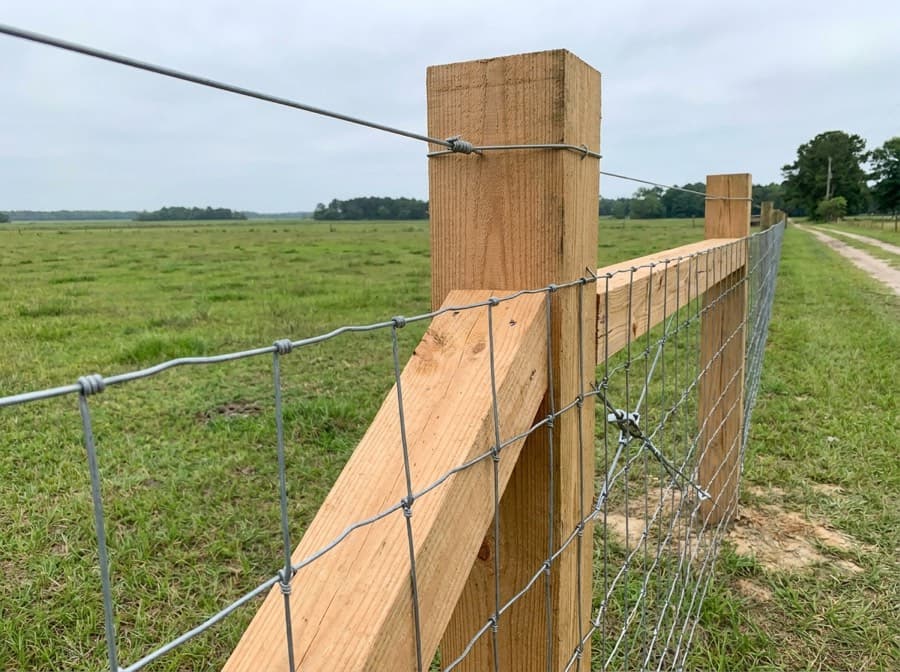
Woven wire is the workhorse of eastern North Carolina farm fencing — one fence that holds cattle, turns goats, keeps dogs out of the pasture, and marks the line for decades when it's built right. Built right is the catch: woven wire only works stretched tight, and it's only as tight as the braces holding it. We install field fence, fixed-knot, and specialty woven mesh across the farm counties around Jacksonville — corners and ends braced first, wire stretched to tension, gates hung to finish. Furnish and install, quoted by the linear foot.
- Licensed & Insured
- Workmanship Warranty
- Local Onslow Crew
- Standard field fence for general livestock and property lines
- Fixed-knot high-strength mesh for long runs and hard use
- Tighter-opening mesh for goats, sheep, and mixed stock
- Hog-tight builds with snug bottom clearance
- Barbed or smooth top strand above the mesh where it helps
Request a Woven Wire Fence Quote
Tell us about your woven wire fence project — property location, install or repair, and any details. We'll follow up with next steps.
- Tap your fence type and rough length
- Name and phone — email optional
- We follow up to talk through the project
- Written pricing after we measure on-site
Prefer to talk it through?
(910) 708-9268No pressure — we’ll follow up to learn about your project and the next steps.

What kind of fence are you looking at?
Pick the closest — we'll talk details when we follow up.
When woven wire fence makes sense
- Working farms fencing pasture and perimeter in one build
- Homesteads that want one fence for animals, dogs, and the line
- Properties replacing rusted field fence on its original posts
- Runs that need to turn small stock as well as hold large
- Rural property lines where a visible, permanent fence settles things
Where woven wire fence fits
Pasture perimeter
47-inch field fence on wood or steel posts with braced corners — the default eastern NC farm fence.
Goat- and hog-tight
Smaller-opening mesh, snug to the ground, sized so stock can't get a head through or a snout under.
Taller exclusion runs
6-foot woven mesh where deer pressure or property use calls for height beyond the standard heights.
Re-fencing old lines
Tearing out rusted wire, evaluating which posts still have life, and stretching new mesh on a rebuilt line.
Jacksonville, NC considerations
The difference between woven wire that sags in three years and woven wire that's tight in twenty is almost entirely in the corners — and in our sandy coastal soils, brace posts want depth and sometimes concrete before they can take fence tension. Inland toward Duplin and Lenoir counties the clay holds better but the runs get longer. Either way we walk the line first: terrain dips, wet spots, and old wire all change how the fence gets built and braced.
What drives woven wire fence pricing
We don't post exact prices because every project is different. These are the factors that matter most when we work up an estimate.
Standard field fence costs less than fixed-knot or small-opening specialty mesh; heavier gauge and denser knots cost more and last longer.
47-inch standard runs cheaper than taller mesh — taller wire also means longer posts set deeper.
Each brace assembly is a small structure of its own. The more direction changes, the more braces.
A barbed or smooth strand above the mesh adds a line of material but protects the mesh from leaning stock.
Tearing out and hauling off rusted wire and failed posts adds labor before the new fence starts.
Ready to fence the line?
Give us the rough footage and what the fence has to hold. We'll walk it and put a real per-foot number on it.
Questions worth asking
- 1What has to stay in — and what has to stay out?
- 2Is the line surveyed, or do we need to confirm it first?
- 3How many corners, ends, and gate openings will the run have?
- 4Standard height, or is there deer pressure arguing for taller?
- 5Are any existing posts worth keeping?
Our process
- 1
Walk and measure
Real footage, real corner count, real ground conditions — the quote is only as good as the walk.
- 2
Brace the bones
Corners, ends, and gate posts built and set first. This is the part that decides whether the fence stays tight.
- 3
Stretch and finish
Mesh stretched to tension against the braces, stapled or clipped to line posts, top strand and gates to finish.
Helpful guides before you build
Short, specific reads tied to this kind of project.
Planning Farm and Pasture Fencing in Onslow County
How acreage changes fence math: matching fence to animal, gate sizing, brace posts, wet ground, and NC 811.
Read guide →Why Fence Posts Fail in Sandy Coastal Soil — and How to Set Them Right
Sandy Onslow County soil doesn't grip posts like clay — what proper depth, footings, and drainage look like here.
Read guide →Fence Cost in Jacksonville, NC
What actually drives fence cost in Jacksonville — materials, length, gates, terrain, HOA rules.
Read guide →Related fence services
Other fence services in Jacksonville, NC that may be relevant for your property.
Farm Fence Installation
Field fencing, barbed wire, high-tensile, woven wire, and ranch-rail for working farms across Duplin, Sampson, Lenoir, Wayne, Craven, and Onslow counties.
View →Cattle & Livestock Fencing
Woven wire, high-tensile, and barbed wire for cattle, goats, sheep, and hogs — built and braced for herd pressure on working farms.
View →High-Tensile & Barbed Wire Fencing
Electrified high-tensile and multi-strand barbed wire for long runs — the budget-per-foot answer on big acreage.
View →Chain Link Fence Installation
Galvanized and vinyl-coated chain link fences for yards, commercial lots, dog runs, and storage areas.
View →Woven Wire Fence across Onslow County and nearby NC communities
We work across Jacksonville and the surrounding area. See the area page for local context.
Jacksonville, NC
Home market — residential, commercial, and military-family fencing across Jacksonville's neighborhoods.
Richlands, NC
Rural and small-town fencing — privacy, ranch, and farm builds across Richlands and the surrounding countryside.
Sneads Ferry, NC
Coastal fencing — privacy, vinyl, and aluminum builds for Sneads Ferry homes near the water.
Swansboro, NC
Coastal-town fencing for homes, marinas, and small businesses in and around Swansboro.
Onslow County, NC
County-wide service — residential, commercial, and farm fencing across Onslow County.
Piney Green, NC
Residential fencing on the eastern side of Jacksonville — privacy, wood, and vinyl.
Half Moon, NC
Residential privacy and containment fencing in the commuter neighborhoods just north of Jacksonville.
Camp Lejeune area, NC
Off-base residential fencing for families living in the Camp Lejeune area.
Frequently asked questions
What's the difference between woven wire and welded wire?
Woven wire is knotted at every intersection so it flexes under impact and springs back — that's why it's the farm standard. Welded wire is rigid and pops welds when livestock hit or lean on it; it belongs on garden beds and kennels, not pasture. If an installer quotes welded wire for livestock, keep asking questions.
What post spacing does woven wire fence need?
Typically 10 to 16 feet between line posts depending on terrain, mesh grade, and the animals — tighter where stock concentrates, wider on smooth ground with fixed-knot wire. Corners and ends are the real story: spacing matters less than bracing.
How long does woven wire fence last?
Galvanized field fence on a well-braced line commonly runs 20 years and more in our climate. The usual failure points are rusted bottom wire in wet spots and corners that were never braced right — both are build-quality problems, not wire problems.
Can you match a fence to a cost-share spec?
Yes. NRCS and Soil & Water fencing practices come with a written spec — wire class, post depth, brace design. Show us the plan and we'll build to it from the first measurement.
Do you sell rolls of woven wire?
No — we're not a supply store. We furnish wire, posts, and hardware as part of an installed fence, and the per-foot quote covers the whole job.
Ready to request woven wire fence pricing?
Use the estimate form above or give us a call — we'll come back with next steps.