Planning Farm and Pasture Fencing in Onslow County
Farm fencing is a different project than a backyard fence, and the difference isn't just length. When you're planning a pasture fence in Onslow County — or out in Jones County, Richlands, Maysville, or toward Beulaville — the scale changes the math, the animals change the design, and the land itself gets a vote. Here's how we'd walk a rural property before quoting it.
Why farm fencing math is different from a backyard fence
A subdivision privacy fence in Jacksonville might run 150 to 250 linear feet. A modest pasture perimeter can run 1,500 feet, and a full property boundary on acreage can run several thousand. At that scale, every per-foot decision multiplies: a slightly heavier wire or closer post spacing barely moves the total on a backyard job, but on 2,000 feet it becomes a real line item.
The flip side works in your favor too: long, straight, uninterrupted runs are efficient to build, so per-foot cost usually comes in below the same material in a tight backyard. The expensive parts of a farm fence aren't the straightaways — they're the corners, the gates, and the wet spots. Our fence cost guide covers the general drivers; on acreage, the driver list gets shorter but each one gets heavier.
Match the fence to the animal, not the catalog photo
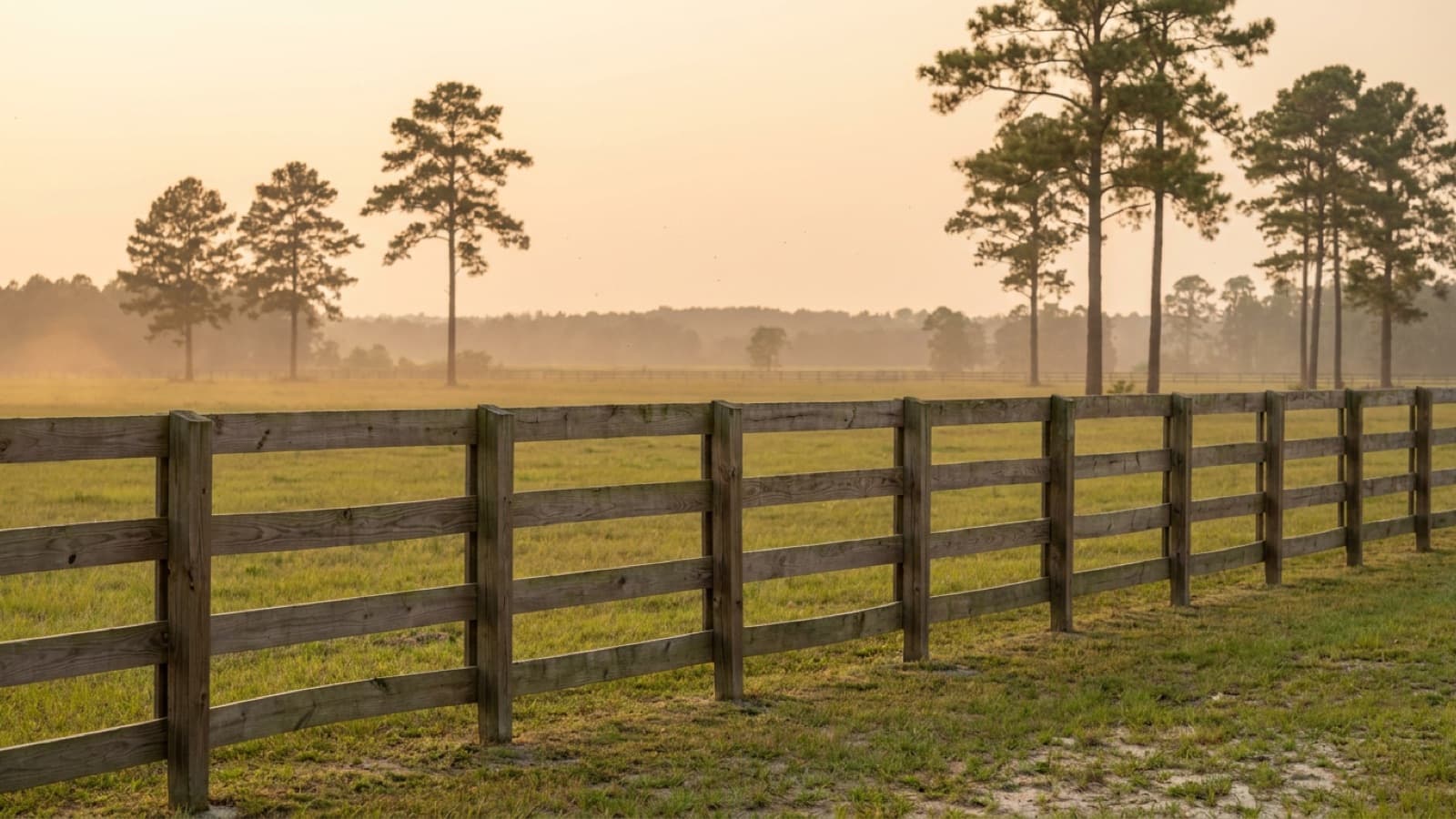
The right farm fence starts with a blunt question: what is it holding in, and what is it keeping out? Horses want visibility — they need to see the fence, which is why board fence and other high-visibility designs are the traditional horse standard. A horse that hits a fence it didn't see gets hurt; a fence a horse can see gets respected.
Mixed livestock — goats, sheep, cattle in smaller numbers — is usually woven wire (field fence) territory. The graduated mesh holds smaller animals that would walk straight through board fence, and goats will test every fence you build like it's their job, because it is. Dogs and general boundary control near the house often land on woven wire or heavy chain link. Tell us the animals first and the fence type usually picks itself.
The honest word on what we do and don't install
We build physical farm fencing: wood board fence, woven and field wire on wood posts, gates, corners, and braces. Electric fencing — energizers, poly tape, insulators, grounding rods, and the charged-wire systems that go with rotational grazing — is a different specialty with its own suppliers and its own installers, and we'd rather say that plainly than sell you a halfway version of it.
The two worlds do meet: plenty of Onslow and Jones County properties add an electric offset wire to a physical perimeter later, and a well-built fence is the right skeleton for that. If your whole plan is temporary paddock tape and a solar energizer, you don't need us — and we'll tell you so.
Size your gates for the biggest thing that will ever pass through
This is the most common regret we hear about on existing farm fences: gates sized for people on a property that runs equipment. A walk gate handles a person and a wheelbarrow. A tractor with an implement wants 12 feet minimum. A truck swinging a stock or equipment trailer into the opening — not approaching it dead straight — wants 14 to 16 feet, because the turning arc eats the opening.
Count your gates while walking the line, then add one: field entrances, the lane to the barn, where the hay gets delivered. Cutting a new gate into a tensioned wire fence later means rebuilding braces on both sides of the opening — far more work than framing it on day one.
Corners and brace posts: where farm fences live or die
A wire farm fence is a tension system. The wire only stays tight because something at each end and each corner is anchoring hundreds of pounds of pull, year after year, through wet winters and dry Augusts. That something is the brace assembly: oversized corner posts set deep, a horizontal rail to a second post, and a diagonal wire that turns the whole thing into a truss.
When you see a sagging field fence along a road in Richlands or Maysville, the wire usually isn't the failure — the corners are. A leaning corner post lets the tension off the entire run, and no amount of re-stretching fixes it until the anchor is rebuilt. This is the part of a farm fence where cutting corners is literal, and the part we're pickiest about.
Sandy soil and wet ground: the coastal complication
Onslow County soil is generally sandy, which digs easy and holds poorly — the same trade-off we deal with on every fence in the region, magnified by farm-fence tension loads. Sandy ground means corner and gate posts need extra depth and properly sized concrete footings, because a brace assembly that would hold fine in clay can slowly creep in sand.
Bottomland is the bigger planning issue. If your fence line crosses low ground near a creek, a drainage ditch, or one of the soft pockets that show up all over rural Onslow and Jones County, mark it. Wet spans may need different post treatment, extra bracing, or a slight reroute up the grade — a line that detours 30 feet to stay on firm ground outlasts one that marches straight through the soft spot. Our post on setting fence posts in sandy coastal soil goes deeper on the ground itself.
Line clearing is usually its own conversation
Backyard fence lines are mostly clear. Farm fence lines often aren't — old fence rows grow up in brush, volunteer pines, and the occasional strand of ancient rusted wire swallowed by a tree. Before a new fence goes in, that line has to be cleared wide enough to work, and on long runs that can be a meaningful scope of its own, sometimes involving equipment beyond fence-crew tools.
Walk your line and be honest about what's on it. A clean pasture edge is ready to fence; a 1,200-foot hedgerow of 15 years' growth is a clearing project first and a fence project second. Either way it's worth discussing as a separate line item up front rather than letting it hide inside a fence quote.
NC 811 applies on the farm too
North Carolina law requires calling NC 811 before digging so underground utilities get marked — that's a real legal requirement, not a suggestion, and it applies to a pasture corner post the same as a backyard post. Rural properties can lull people into skipping it because the land looks empty. It often isn't: buried power to the barn or well pump, water lines to frost-free hydrants and stock tanks, septic lines and drain fields, and utility easements crossing acreage are all common finds.
811 locators mark public utilities; privately run lines — like the water line a previous owner trenched to the back pasture — are yours to know about and flag. On a fence with hundreds of post holes, one unmarked line is one too many. We handle the 811 ticket on our installs; sketch what you know about your own buried lines before anyone digs.
Maintenance rhythm for long runs
A farm fence isn't install-and-forget, but the maintenance is light if it's rhythmic. Walk or ride the full line twice a year — spring and fall — and after any named storm. You're looking for leaning corner posts, slack wire, cracked boards, limbs down on the line, and spots where animals have been pressing or rubbing.
The economics are simple: re-tensioning one slack section is a same-day fix; ignoring it for two years turns it into a rebuilt run. Our post on fence lifespan in coastal North Carolina covers what weather does to materials here; on a farm the same forces just have more feet of fence to work on.
The planning walk: how to get a quote that holds up
Before calling anyone, walk your fence line — the whole thing, not the view from the porch. Bring your phone. Mark or photograph the wet spots and low crossings. Count every place equipment, animals, or people will need to pass through, and note the widest vehicle. Note the corners, what's growing on the line, and whether any old fence needs to come out first.
Then send us that: rough line length (an aerial screenshot from any map app with the line sketched on it is genuinely useful), the animals, the gate count and widths, and photos of the tricky spots. A quote built from that holds up; a guess from a road drive-by doesn't. Larger acreage jobs are worth a site visit, and we'd rather walk it with you than surprise you on install day. Our fence permit guide covers confirming requirements with Onslow County or your jurisdiction — rural land often has fewer hurdles than town lots, but confirm rather than assume.
Want a real fence estimate?
Send a few project details and we'll come back with next steps. Most details are optional — share what you can.
- Tap your fence type and rough length
- Name and phone — email optional
- We follow up to talk through the project
- Written pricing after we measure on-site
Prefer to talk it through?
(910) 708-9268No pressure — we’ll follow up to learn about your project and the next steps.

What kind of fence are you looking at?
Pick the closest — we'll talk details when we follow up.
Frequently asked questions
Do you install electric fencing for rotational grazing?
No — energizers, poly tape, and charged-wire systems are a different specialty, and we'd rather say so than improvise. We build the physical fencing: board fence, woven wire, gates, and the corner braces that hold it all tight, which makes a solid skeleton for an electric offset wire added later.
How wide should my farm gates be?
Size for the biggest thing that will ever pass through, then add margin. A tractor with implements wants 12 feet minimum; a truck swinging a trailer into the opening wants 14 to 16 feet. Adding a gate to a tensioned wire fence later means rebuilding braces on both sides, so count generously up front.
Can you fence through a wet area or creek bottom?
Usually, with adjustments — deeper posts, extra bracing on both sides of the low ground, and sometimes a short reroute up the grade, which often outlasts a straight line through the soft spot. Mark your wet areas before the estimate walk so they get planned instead of discovered.
Do you clear overgrown fence lines?
Light brush along the line is normal fence-prep. A seriously overgrown fence row — years of brush, volunteer trees, old wire grown into trunks — is a clearing scope of its own and worth discussing separately before the fence quote. We'll flag it honestly during the estimate rather than burying it in the fence number.
How do I get an accurate quote for acreage fencing?
Walk the full line first. Send us rough line length (an aerial screenshot with the line sketched works), the animals, gate count and widths, and photos of wet or overgrown sections. Larger farm jobs get a site visit — a quote from a real walk holds up; a guess from the road doesn't.
Browse related fence services
Specific services in Jacksonville, NC that connect to this article.
Farm Fence Installation
Field fencing, barbed wire, high-tensile, woven wire, and ranch-rail for working farms across Duplin, Sampson, Lenoir, Wayne, Craven, and Onslow counties.
Learn more →Gate Installation
Walk gates, double gates, driveway gates, and matching gates for any fence type.
Learn more →Chain Link Fence Installation
Galvanized and vinyl-coated chain link fences for yards, commercial lots, dog runs, and storage areas.
Learn more →More from Jacksonville Fence Company
Fence Cost in Jacksonville, NC
What actually drives fence cost in Jacksonville — materials, length, gates, terrain, HOA rules.
Do You Need a Fence Permit in Jacksonville, NC?
The straight answer for the city and the county — plus the height rules, property-line, HOA, and 811 steps that still apply.
Why Fence Posts Fail in Sandy Coastal Soil — and How to Set Them Right
Sandy Onslow County soil doesn't grip posts like clay — what proper depth, footings, and drainage look like here.
How Long Does a Fence Last in Coastal North Carolina?
Honest lifespan ranges for wood, vinyl, chain link, and aluminum fences in coastal Onslow County — and what shortens or extends them.
How to Choose a Fence Contractor in Jacksonville, NC
The questions that separate pros from trucks-with-ladders — and the red flags that should end the conversation.
Planning fence for acreage in Onslow or Jones County?
Send us your line length, animals, and gate count — or ask us to walk the property with you. We quote farm and pasture fencing at no cost, we'll tell you straight what your land needs, and there's no high-pressure pitch. If part of the job isn't ours to do, we'll say so.