Farm Fence Installation in Jacksonville, NC
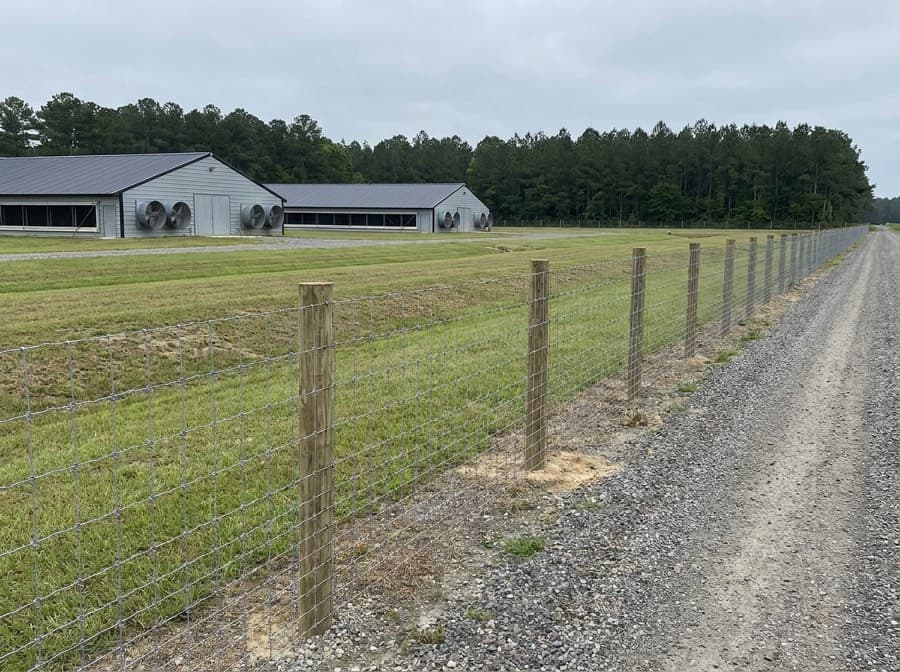
Farm and pasture fencing is its own world. From our Jacksonville base we build farm fence across eastern North Carolina's real farm country — woven wire and high-tensile runs for cattle operations in Duplin and Sampson counties, horse fencing around Kenansville, Wallace, and Beulaville, and long pasture perimeters out through Kinston, Mount Olive, and the Craven County line. Projects range from a paddock around a small homestead to multi-thousand-foot runs on working farms — our latest large build was 6,500 linear feet of woven wire with a barbed top strand. We work with the property owner on materials that fit the livestock, the terrain, and the budget, and we quote by the linear foot.
- Licensed & Insured
- Workmanship Warranty
- Local Onslow Crew
- Woven wire and field fencing
- Barbed wire and high-tensile
- Three- and four-rail wood ranch fencing
- Gate placement and wide farm gates
If you already know what the animals need, go straight to the fence type: cattle and livestock fencing for cow-calf and stocker operations, sized and braced for pressure at the fence line.
For horses, board and mesh are their own conversation — see horse fencing, including no-climb 2x4 mesh and board-with-mesh combinations.
For general pasture and perimeter work, woven wire and field fence installation covers the workhorse of eastern NC farm fencing.
On long runs where budget per foot matters most, high-tensile and barbed wire fencing — including electrified high-tensile — usually wins.
Request a Farm Fencing Quote
Tell us about your farm fencing project — property location, install or repair, and any details. We'll follow up with next steps.
- Tap your fence type and rough length
- Name and phone — email optional
- We follow up to talk through the project
- Written pricing after we measure on-site
Prefer to talk it through?
(910) 708-9268No pressure — we’ll follow up to learn about your project and the next steps.

What kind of fence are you looking at?
Pick the closest — we'll talk details when we follow up.
When farm fencing makes sense
- Cattle, horse, or small-stock containment on working properties
- Hobby farms, homesteads, and rural lifestyle properties
- Long-run property line fencing on rural acreage
- Mixed-use farms with garden, livestock, and equipment areas
- Ranch-style frontage fences that double as visual property markers
Where farm fencing fits
Pasture and livestock
Cattle, horse, and small-stock fencing in widths and gauges sized to the animals.
Property line
Long runs of perimeter fence on rural lots.
Homesteads and small farms
Mixed fence types around hobby farms, gardens, and chicken areas.
Ranch frontage
Three- and four-rail wood or vinyl ranch fences for entry roads and front frontage.
Jacksonville, NC considerations
Eastern NC farm country runs from sandy coastal soil to heavier clay inland through Duplin, Sampson, and Lenoir counties — and post setting, bracing, and drainage all change with it. Long fence runs need proper corner-bracing and gate spacing: tractors, trailers, and feed deliveries all need access. Many producers in our area also work with NRCS or their county Soil & Water Conservation District on fencing cost-share — if that's you, mention it up front, because building to the conservation plan's spec from the first measurement matters. We walk the line in person on farm projects because terrain, trees, and access points shape the build.
What drives farm fencing pricing
We don't post exact prices because every project is different. These are the factors that matter most when we work up an estimate.
Long runs spread setup cost over more length, often per-foot price drops vs. a short run.
Barbed wire is cheaper per foot; high-tensile and woven wire cost more but contain different animals.
Wood vs. steel posts, plus spacing based on animals and terrain.
Wide farm gates (12'-16') cost more per opening than a single walk gate.
Wooded or overgrown property lines need clearing before the build.
Need farm or pasture fencing?
Tell us about the property, the animals, and the rough acreage. We'll work up a quote.
Questions worth asking
- 1What animals will this fence contain or exclude?
- 2How long is the total run, and where do gates need to go?
- 3Is the property line surveyed?
- 4Are corners and gateposts in places that can be braced properly?
- 5Will I need to clear the line first?
Our process
- 1
Walk the property
Long-run farm fences benefit from a real walk-through to understand terrain, drainage, and access.
- 2
Recommend
Materials, post type, and corner-bracing recommendations sized to the use.
- 3
Build
Set corners and braces first, then the line, then the gates.
Helpful guides before you build
Short, specific reads tied to this kind of project.
Fence Cost in Jacksonville, NC
What actually drives fence cost in Jacksonville — materials, length, gates, terrain, HOA rules.
Read guide →Do You Need a Fence Permit in Jacksonville, NC?
The straight answer for the city and the county — plus the height rules, property-line, HOA, and 811 steps that still apply.
Read guide →Planning Farm and Pasture Fencing in Onslow County
How acreage changes fence math: matching fence to animal, gate sizing, brace posts, wet ground, and NC 811.
Read guide →Related fence services
Other fence services in Jacksonville, NC that may be relevant for your property.
Cattle & Livestock Fencing
Woven wire, high-tensile, and barbed wire for cattle, goats, sheep, and hogs — built and braced for herd pressure on working farms.
View →Horse Fencing
No-climb 2x4 mesh, three- and four-board fence, and board-with-mesh combinations — horse-safe fencing for paddocks and pasture.
View →Woven Wire & Field Fence Installation
Field fence, fixed-knot, and woven mesh stretched tight on braced corners — the workhorse fence of eastern NC farms.
View →High-Tensile & Barbed Wire Fencing
Electrified high-tensile and multi-strand barbed wire for long runs — the budget-per-foot answer on big acreage.
View →Gate Installation
Walk gates, double gates, driveway gates, and matching gates for any fence type.
View →Farm Fencing across Onslow County and nearby NC communities
We work across Jacksonville and the surrounding area. See the area page for local context.
Jacksonville, NC
Home market — residential, commercial, and military-family fencing across Jacksonville's neighborhoods.
Richlands, NC
Rural and small-town fencing — privacy, ranch, and farm builds across Richlands and the surrounding countryside.
Sneads Ferry, NC
Coastal fencing — privacy, vinyl, and aluminum builds for Sneads Ferry homes near the water.
Swansboro, NC
Coastal-town fencing for homes, marinas, and small businesses in and around Swansboro.
Onslow County, NC
County-wide service — residential, commercial, and farm fencing across Onslow County.
North Topsail Beach, NC
Coastal fencing — aluminum, vinyl, and pool fencing for North Topsail Beach homes.
Surf City, NC
Coastal fencing for Surf City — aluminum, vinyl, and pool fences for Topsail Island and the mainland.
Maple Hill, NC
Rural-property fencing for Maple Hill — pasture, chain link, and privacy builds on large lots and acreage.
Furnish and install — we're not a fence supplier
A lot of farm-fence searches end at a farm store's loading dock. That's not us. We don't sell rolls of wire, T-posts, or panels — we're a fencing contractor. We furnish the materials for your job, build the corners and braces, stretch the wire, and hang the gates, and the quote covers all of it by the linear foot.
That matters because on a farm fence the materials are the cheap part. The fence that stays tight for twenty years is the one with the right brace assemblies at the corners and ends, posts set for the soil they're in, and wire stretched to the right tension — which is exactly the part a roll of wire from the store doesn't come with.
Which fence for which animal
Cattle do well behind woven wire, high-tensile (usually electrified), or classic barbed strands, and the right answer often depends on run length and how hard the herd pushes the line. Horses need mesh they can't get a hoof through and nothing that cuts — no-climb 2x4 woven mesh, board fence, or both together, and never barbed wire. Goats and sheep are escape artists and predators are half the problem, so tighter woven mesh with smaller openings earns its keep. Hogs test the bottom of a fence, not the top.
Most working properties end up with more than one type — woven wire on the perimeter, electric cross-fencing to rotate pasture, board or no-climb around the horse paddock, and wide gates wherever equipment moves. We'll walk the property and spec each run for what it actually has to hold.
Frequently asked questions
How far apart should farm fence posts be?
Depends on the fence type and the livestock. Woven wire and high-tensile usually have 10'-16' spacing; wood ranch rail is usually 8'.
Do you do long-run pasture fencing?
Yes, including longer runs on rural properties. We'll discuss equipment access and access points.
Can you handle wooded property lines?
We can fence along wooded lines, though tree removal, clearing, or boundary confirmation may be needed before the build.
What's the difference between high-tensile and barbed wire?
High-tensile is smoother, often electrified, and contains animals through psychological barrier. Barbed wire is the traditional 3- or 4-strand approach.
Do you do horse-safe fencing?
Yes — wood rail, vinyl rail, and high-tensile horse fence are common. Avoiding barbed wire near horses is usually the goal.
Ready to request farm fencing pricing?
Use the estimate form above or give us a call — we'll come back with next steps.