
Why Fence Posts Fail in Sandy Coastal Soil — and How to Set Them Right
Almost every leaning fence we get called to in Onslow County has the same root cause: fence posts set in sandy soil the way you'd set them in clay. Sand doesn't grip a post — it drains, shifts, and slowly lets go, and a fence that looked perfect on install day starts tilting three or four years later. Here's what sandy coastal soil does to a post, what proper fence post depth in sandy soil looks like, and how to tell whether the crew quoting your project understands the difference.
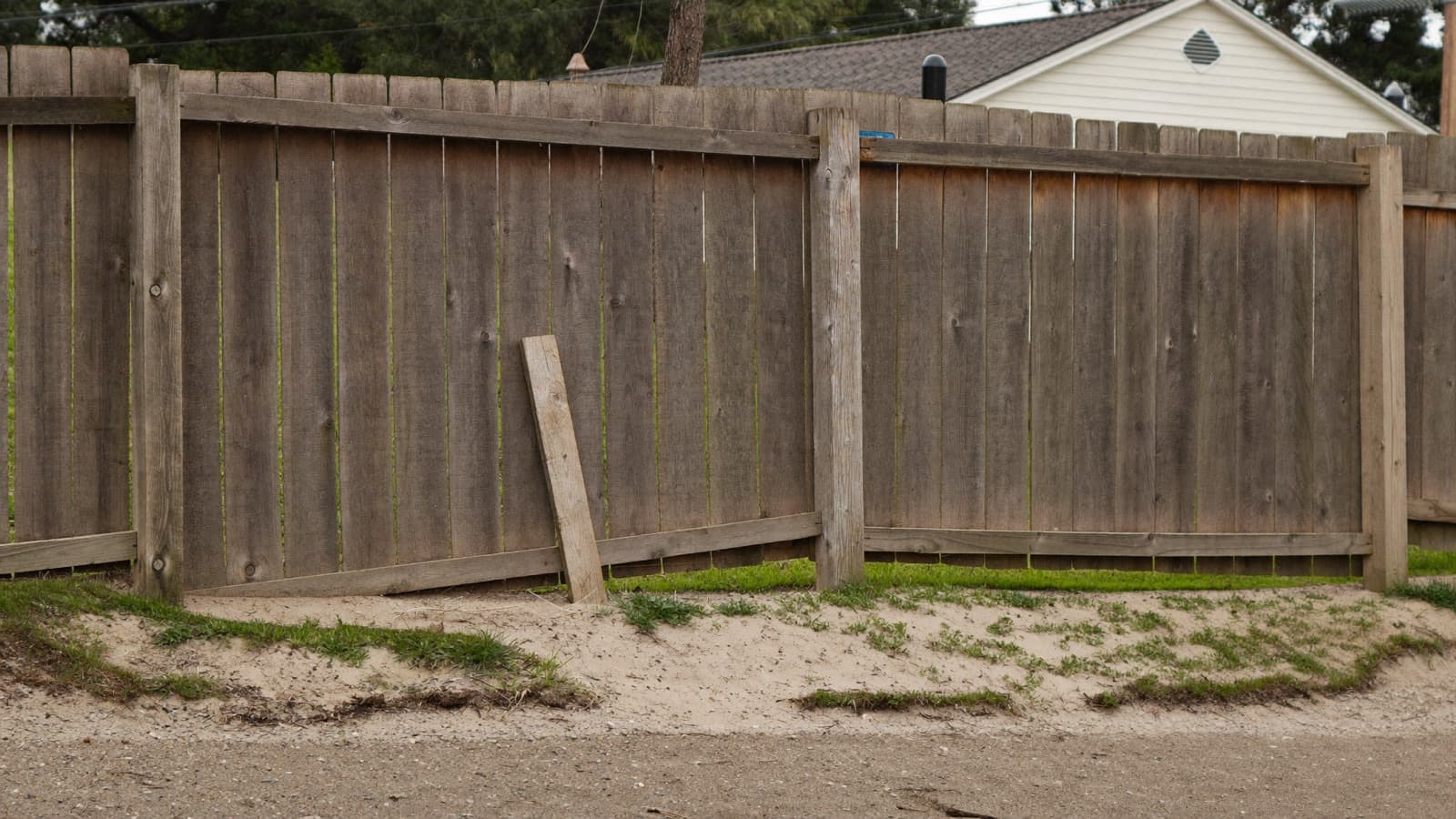
Why sandy soil doesn't hold fence posts like clay does
Clay grips. Set a post in clay country and the soil packs back and clamps on — the ground itself does much of the holding. Sand grains don't stick to each other; they hold a post through friction and confinement alone, and every time the post moves, a few grains rearrange and the hole gets a hair looser.
Most of Jacksonville, Hubert, Sneads Ferry, and the beach communities down through Holly Ridge and North Topsail sit on sand or sandy loam. That's great for drainage and lousy for lateral resistance — the sideways loads a fence sees every windy afternoon. An install technique imported from clay country will pass inspection by eyeball and fail by year five.
The lean: how post failure announces itself here
Sandy-soil failure almost never looks like a snapped post. It looks like a lean — one post a couple degrees off plumb after a windy winter, then a gate that misses its latch, then a whole run drifting like it's had a long day. Sight down the top of the fence line and you'll spot it long before you'd notice it panel by panel.
The mechanics are simple: wind rocks the post, the post wallows out a cone of loose sand at the ground line, and the widened socket lets the next gust rock it further. Caught early, a loose post can often be reset; ignored, it takes its neighbors with it — our guide on fence repair versus replacement covers where that line falls.
How deep should fence posts go in sandy soil?
Deeper than the habit most crews bring with them. The old carpenter's rule — bury a third of the total post height — is a floor here, not a target. For a 6-foot privacy fence in the sandy ground around Jacksonville, we dig noticeably deeper than the two-feet-everywhere standard that gets by in stiffer soil, with gate and corner posts deepest because they carry the most load.
Depth is the cheapest strength you can buy in sand: every extra inch of embedment moves the pivot point further underground and puts more confined material around the post. That extra auger time and concrete is exactly what a bargain bid quietly skips — you can't see hole depth in a finished fence, and some outfits count on that.
Concrete, and why the footing's shape matters
In sandy soil we set structural posts in concrete — sand alone won't hold. The footing's shape matters as much as the mix. A straight cylinder of concrete in loose sand is just a bigger post; it can still rock and lift. What you want is a bell-shaped footing — wider at the bottom of the hole than at the top — so the footing has to move a wedge of earth to tilt or pull out, not just slide through it.
Belling the hole is unglamorous shovel work nobody sees once it's buried — and one of the clearest separators between a crew that understands coastal soil and one that digs, dumps, and drives on.
Compaction and drainage: the steps that vanish when nobody's watching
Loose sand poured back into a hole has almost no strength — it needs to be compacted in lifts, a few inches at a time, tamped hard. Same at the base of the hole: a post standing on fluffed-up sand settles, and a settled post drops panels and racks gates. Compaction is slow, boring, and invisible in the finished product, and it's part of why two quotes for the same fence land far apart — our fence cost guide gets into it — because part of what you're paying for is buried.
Drainage at the ground line is the other invisible detail. The top of the concrete footing should be crowned — sloped so water sheds away from the post — and finished at or slightly above grade. Done wrong, the concrete cures into a shallow cup that catches every rainstorm and holds it against the wood; in a climate that gets tropical rain by the inch, that cup becomes a permanent moat. It's a thirty-second trowel detail, and it's the difference between a post that dries out after rain and one that sits in a puddle of its own footing for fifteen years.
A solid privacy fence is a sail — and the post is the mast
A 6-foot solid privacy panel catches wind like a sail, and the post is the mast — with the ground line as the fulcrum. Every gust becomes leverage prying the post through the sand. A picket fence with gaps can survive a mediocre install for years; a solid panel fence on the same posts leans after its first serious storm season.
Between everyday onshore breeze off the New River and the named storms that visit Onslow County, a privacy fence here sees thousands of hours of side load. Most of our customers want solid privacy anyway — the answer isn't a different fence, it's posts set for the job. Our hurricane prep post covers what wind does to the weak points in an existing fence.
Ground-line rot works differently in sand than in clay
Here's the one genuine favor sand does you: it drains. In clay, water sits in the post hole and the buried section of a wood post stews; in sand, the buried section often stays surprisingly sound. The trade is that the failure zone concentrates in the few inches right at grade, where moisture, oxygen, and soil contact all meet — the exact spot where wind load bends the post hardest.
So a wood post here can look fine at eye level, be sound below grade, and still be soft as bread at the ground line. Probe at grade with a screwdriver — solid wood pushes back, rot gives — and you'll find the problem while it's still one post instead of a fence.
Why the bargain install fails at year three to five
The timeline is consistent enough that we can almost date a fence by its lean. Year one, the cheap install and the proper install look identical — sand holds anything for a season. By years three through five, storm seasons have worked the shallow posts loose — the lean shows up, gates stop latching, the calls start. Shallow holes, dry-set posts, loose backfill, and cylinder footings all fail on about this schedule.
Jacksonville adds a wrinkle: Camp Lejeune's constant PCS turnover means a lot of homes change hands inside that window, and the new owner inherits the lean with no one to call. If you're buying a home here, push on a few fence posts during the walkthrough — it tells you more than the fresh stain does.
Call NC 811 before anyone digs — it's the law
One part of post setting isn't judgment or technique: North Carolina law requires notifying NC 811 before digging — at least three full working days ahead — so buried utilities can be marked. That applies to a contractor's auger and your post-hole digger alike, and the locate is free. The ground here is busier than people expect: irrigation, buried power, cable, and gas thread through neighborhoods from Piney Green to Swansboro.
Any contractor should handle the 811 locate as routine. A crew ready to dig tomorrow with no locate on record isn't hustle — it's a preview of every other step they skip.
What to ask any fence contractor about post setting
You can't inspect a buried footing after the fact, so ask before the dig. Five questions do most of the work: How deep are you setting posts for my fence height, and why? Which posts get concrete? Do you bell the bottom of the hole? How do you finish the concrete at the ground line? And how long do posts cure before panels go on?
A crew that sets posts for sandy soil answers in specifics without blinking. Vague answers — "we do two feet, standard" — or a quote dramatically below every other bid usually mean the difference is underground, where you won't find it until year three. We'll give you our own answers on any estimate, and you're welcome to hold us to them.
Want a real fence estimate?
Send a few project details and we'll come back with next steps. Most details are optional — share what you can.
- Tap your fence type and rough length
- Name and phone — email optional
- We follow up to talk through the project
- Written pricing after we measure on-site
Prefer to talk it through?
(910) 708-9268No pressure — we’ll follow up to learn about your project and the next steps.

What kind of fence are you looking at?
Pick the closest — we'll talk details when we follow up.
Frequently asked questions
How deep should fence posts be set in sandy soil?
Treat the old rule — bury a third of the post's total height — as a minimum, not a target. For a 6-foot privacy fence around Jacksonville, we dig deeper than the standard that gets by in clay country, and gate and corner posts go deeper still. Depth is the cheapest strength you can add in sand.
Do fence posts in sandy soil always need concrete?
For a solid privacy fence in sand, yes — that's how we set them, with a bell-shaped footing rather than a straight cylinder. Gravel-set posts have their advocates in soils that grip; sand isn't one of them. Under a wind-loaded panel, dry-set posts in sand work loose on a predictable schedule.
Why is my fence leaning after only three or four years?
That timeline is the signature of a shallow or dry-set install in sandy soil: the posts held for a season or two, then storm seasons wallowed out the sockets. It's the most common failure we see in Onslow County — a post-setting problem, not a panel problem.
Can leaning posts be fixed, or does the whole fence need replacing?
Often they can be reset properly — deeper, in concrete, footing done right — with the existing panels reused, as long as the wood or vinyl is still sound. If posts are rotted at the ground line or the lean runs the whole fence, replacement math starts to win. Our repair-versus-replacement guide walks through where that line falls.
Do I really have to call 811 just to set fence posts?
Yes — NC 811 notification before digging is a North Carolina legal requirement, at least three full working days ahead, and it applies to homeowners as much as contractors. The locate is free, and any contractor you hire should handle it as routine.
Browse related fence services
Specific services in Jacksonville, NC that connect to this article.
Fence Installation
New fence builds across Jacksonville and Onslow County for homes, businesses, and farms — built to handle coastal NC conditions.
Learn more →Fence Repair
Storm damage, leaning posts, broken panels, and gate problems — we patch, replace, or rebuild only what needs it.
Learn more →Wood Fence Installation
Pressure-treated pine and cedar-look builds — privacy, picket, shadow box, and ranch styles.
Learn more →More from Jacksonville Fence Company
Fence Repair vs Replacement in Jacksonville, NC
When to patch and when to rebuild — for storm damage, rotten posts, broken panels, and gate sag.
Fence Cost in Jacksonville, NC
What actually drives fence cost in Jacksonville — materials, length, gates, terrain, HOA rules.
How Long Does a Fence Last in Coastal North Carolina?
Honest lifespan ranges for wood, vinyl, chain link, and aluminum fences in coastal Onslow County — and what shortens or extends them.
How to Prepare Your Fence for Hurricane Season in Jacksonville, NC
A pre-season fence walkthrough for coastal Onslow County — plus what to do before a named storm and after one.
The Best Time of Year to Install a Fence in Jacksonville, NC
The honest season-by-season answer — and why winter might be the smartest booking on the calendar.
Want posts set for sand, not clay?
Tell us about your fence line and we'll quote it with the post setting spelled out — depth, concrete, footing shape, the works. No high-pressure pitch: if your existing posts just need a reset instead of a new fence, we'll tell you that straight.