High-Tensile & Barbed Wire Fence Installation in Eastern NC
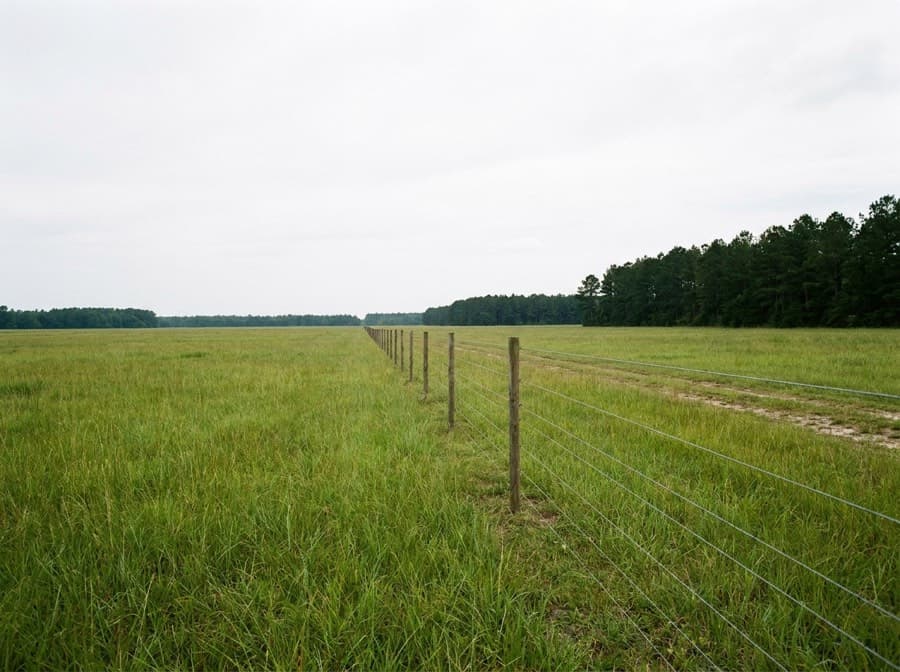
When the run gets long, strand fencing wins the math. High-tensile smooth wire — usually electrified — and traditional barbed wire cover big perimeters and cross-fencing at a fraction of woven wire's cost per foot, and on a well-built line they hold cattle for decades. The build is everything: high-tensile carries real tension, so the corners and ends do the work, and an electric fence is only as good as its grounding. We design and install both across eastern NC's farm counties — furnish and install, quoted by the linear foot.
- Licensed & Insured
- Workmanship Warranty
- Local Onslow Crew
- Electrified high-tensile — the modern long-run standard
- Smooth (slick) wire high-tensile where power isn't wanted
- 3- to 5-strand barbed wire, the traditional cattle fence
- Energizer sizing, grounding, and lightning protection done right
- Cross-fencing and lane layouts for rotational grazing
Request a High-Tensile & Barbed Quote
Tell us about your high-tensile & barbed project — property location, install or repair, and any details. We'll follow up with next steps.
- Tap your fence type and rough length
- Name and phone — email optional
- We follow up to talk through the project
- Written pricing after we measure on-site
Prefer to talk it through?
(910) 708-9268No pressure — we’ll follow up to learn about your project and the next steps.

What kind of fence are you looking at?
Pick the closest — we'll talk details when we follow up.
When high-tensile & barbed makes sense
- Long perimeter runs where woven wire costs too much per foot
- Rotational grazing operations dividing pasture with hot wire
- Cattle operations re-fencing big acreage on a working budget
- Remote lines where low maintenance matters more than looks
- Adding an electric offset to protect an existing fence
Where high-tensile & barbed fits
Electrified perimeter
5- to 8-strand high-tensile with braced ends, in-line strainers, and an energizer sized to the total wire length.
Cross-fencing
1- to 3-strand hot wire dividing pasture into paddocks — the cheapest containment per foot there is.
Barbed wire perimeter
The classic 4-strand cattle fence on wood posts, braced corners, twitched tight.
Offset retrofits
A single hot offset strand that stops stock from leaning on and destroying an existing fence.
Jacksonville, NC considerations
Two local realities shape strand fencing here. First, sandy soil: dry sand is a poor electrical conductor, so grounding systems in our coastal counties need more rods and more care than the energizer box suggests — an electric fence that reads weak at the far end is almost always a grounding problem. Second, storms: hurricanes drop pines on fence lines, and high-tensile's ability to take a hit, be re-tensioned, and go back to work — where woven mesh would need a section replaced — is a real argument for it on wooded lines.
What drives high-tensile & barbed pricing
We don't post exact prices because every project is different. These are the factors that matter most when we work up an estimate.
Cross-fencing might need 2 strands; a bull-tight perimeter wants 6 or more. Each strand is wire, insulators, and time.
Energizer, grounding field, cutout switches, and lightning protection add fixed cost that long runs absorb easily.
High-tensile pulls hard — every end and corner is an engineered brace, and they set the pace of the build.
Dips and rises need extra posts or tie-downs to keep strand spacing honest; wooded lines need clearing first.
Plug-in, battery, or solar energizer — remote lines usually mean solar, which costs more up front.
Long run to fence?
High-tensile math gets better with every foot. Tell us the acreage and the animals — we'll design the line and quote it.
Questions worth asking
- 1Electrified or not — and is there power near the line?
- 2How many strands does the stock actually require?
- 3Where do the ends and corners land, and can they be braced properly?
- 4Who maintains the energizer and checks voltage after storms?
- 5Is barbed wire appropriate — or is this fence anywhere near horses?
Our process
- 1
Design the line
Strand count, brace placement, energizer and grounding plan — on paper before anything goes in the ground.
- 2
Build the braces
Ends and corners built to take the tension. On high-tensile this is most of the job.
- 3
String, tension, energize
Wire run, tensioned with in-line strainers, energizer grounded and tested end to end before we call it done.
Helpful guides before you build
Short, specific reads tied to this kind of project.
Planning Farm and Pasture Fencing in Onslow County
How acreage changes fence math: matching fence to animal, gate sizing, brace posts, wet ground, and NC 811.
Read guide →Fence Cost in Jacksonville, NC
What actually drives fence cost in Jacksonville — materials, length, gates, terrain, HOA rules.
Read guide →Why Fence Posts Fail in Sandy Coastal Soil — and How to Set Them Right
Sandy Onslow County soil doesn't grip posts like clay — what proper depth, footings, and drainage look like here.
Read guide →Related fence services
Other fence services in Jacksonville, NC that may be relevant for your property.
Farm Fence Installation
Field fencing, barbed wire, high-tensile, woven wire, and ranch-rail for working farms across Duplin, Sampson, Lenoir, Wayne, Craven, and Onslow counties.
View →Cattle & Livestock Fencing
Woven wire, high-tensile, and barbed wire for cattle, goats, sheep, and hogs — built and braced for herd pressure on working farms.
View →Woven Wire & Field Fence Installation
Field fence, fixed-knot, and woven mesh stretched tight on braced corners — the workhorse fence of eastern NC farms.
View →Gate Installation
Walk gates, double gates, driveway gates, and matching gates for any fence type.
View →High-Tensile & Barbed across Onslow County and nearby NC communities
We work across Jacksonville and the surrounding area. See the area page for local context.
Jacksonville, NC
Home market — residential, commercial, and military-family fencing across Jacksonville's neighborhoods.
Richlands, NC
Rural and small-town fencing — privacy, ranch, and farm builds across Richlands and the surrounding countryside.
Sneads Ferry, NC
Coastal fencing — privacy, vinyl, and aluminum builds for Sneads Ferry homes near the water.
Swansboro, NC
Coastal-town fencing for homes, marinas, and small businesses in and around Swansboro.
Onslow County, NC
County-wide service — residential, commercial, and farm fencing across Onslow County.
Jones County, NC
Rural Jones County fencing — farm, ranch, and residential builds.
Pender County, NC
Service for the northern Pender County area — coastal, residential, and pool fencing.
Hubert, NC
Suburban fencing for Hubert residents — privacy, wood, and vinyl builds on residential lots.
Frequently asked questions
Do you install electric fence?
Yes — electrified high-tensile is most of our strand-fence work: wire, braces, energizer, grounding field, and testing, installed as one job. We size the energizer to the total wire length and put real attention into grounding, which is where most DIY electric fences fall short in sandy soil.
What is high-tensile electric fencing?
Smooth 12.5-gauge steel wire run at high tension between braced ends, with one or more strands electrified. It contains stock as a psychological barrier — animals learn the fence once and stay off it — which is why 5 strands of it can do the job of much heavier fence.
High-tensile or barbed wire — which should I use?
For new long-run cattle fence, electrified high-tensile usually wins: comparable cost, longer life, less maintenance, and safer around people and equipment. Barbed wire still makes sense un-powered on remote lines and for matching existing fence. Near horses, neither — see our horse fencing page.
What is slick wire fence?
Smooth (barbless) high-tensile wire — same steel, no barbs. Run un-electrified it's a gentle physical barrier; electrified it's the standard modern pasture fence.
How long does high-tensile fence last?
Class 3 galvanized high-tensile on good braces is a 25-to-40-year fence in our climate, and individual strands can be re-tensioned or replaced without rebuilding the line. The braces and grounding do the aging, not the wire.
Ready to request high-tensile & barbed pricing?
Use the estimate form above or give us a call — we'll come back with next steps.