Cattle & Livestock Fence Installation in Eastern NC
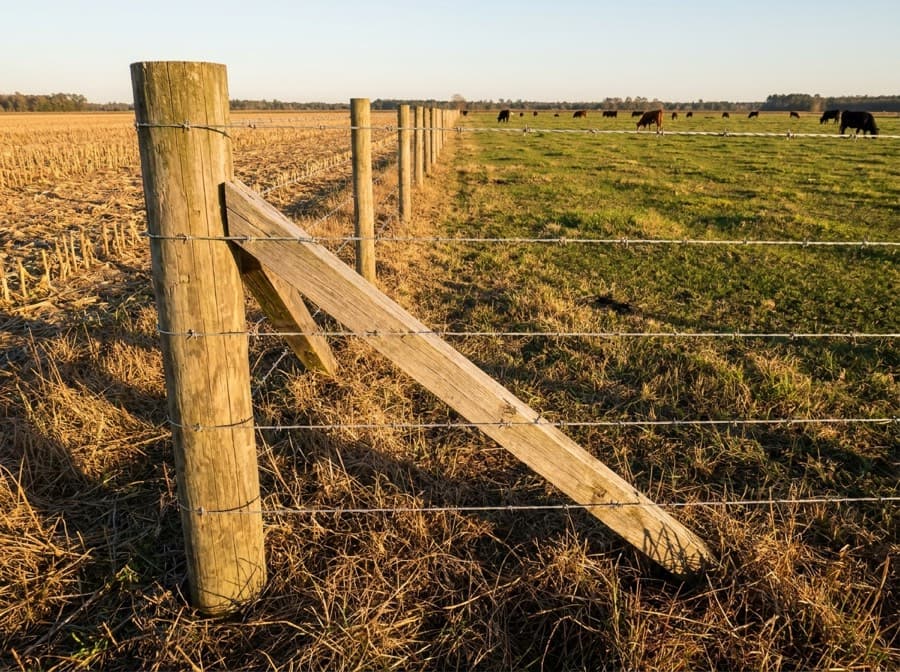
A cattle fence earns its keep at the corners. Wire is wire — what holds a herd is post depth, brace assemblies, and tension, and that's the part we build. From our Jacksonville base we install cattle and livestock fencing across eastern North Carolina's real cattle country — Duplin, Sampson, Lenoir, and Wayne counties and the farms in between. We're a furnish-and-install contractor, not a farm store: we supply the wire, posts, and gates for the job, build it, and stand behind the whole fence, quoted by the linear foot.
- Licensed & Insured
- Workmanship Warranty
- Local Onslow Crew
- Woven wire and fixed-knot field fence for cow-calf operations
- Electrified high-tensile for long perimeter and cross-fencing
- 3- to 5-strand barbed wire where the budget leads
- Tighter mesh for goats, sheep, and mixed small stock
- Corner and end braces built for a pushing herd
Request a Cattle Fencing Quote
Tell us about your cattle fencing project — property location, install or repair, and any details. We'll follow up with next steps.
- Tap your fence type and rough length
- Name and phone — email optional
- We follow up to talk through the project
- Written pricing after we measure on-site
Prefer to talk it through?
(910) 708-9268No pressure — we’ll follow up to learn about your project and the next steps.

What kind of fence are you looking at?
Pick the closest — we'll talk details when we follow up.
When cattle fencing makes sense
- Cow-calf and stocker operations fencing or re-fencing pasture
- Rotational grazing setups that need cross-fencing and lanes
- Goat and sheep containment where predators are part of the problem
- Hog-tight perimeter fence on homesteads and small farms
- Leased pasture that needs a sound perimeter before turnout
Where cattle fencing fits
Perimeter fence
The property-line fence that has to hold everything: woven wire or high-tensile with braced corners and wide equipment gates.
Cross-fencing and paddocks
Electrified high-tensile dividing pasture for rotation — cheaper per foot than perimeter wire and fast to reconfigure.
Working areas
Heavier fence around corrals, lots, and handling areas where animals concentrate and push.
Small-stock runs
Tighter woven mesh for goats and sheep — smaller openings, snugger bottom clearance, and enough height to discourage climbing.
Jacksonville, NC considerations
Cattle numbers in our part of the state concentrate inland — Duplin County alone runs more cattle than the rest of the coastal counties combined, and most of our cattle work is out that way, through Kenansville, Beulaville, Mount Olive, and Kinston. Soil shifts from sand to clay as you move inland, and post depth and brace design change with it. Many producers here fence with NRCS or Soil & Water cost-share money; if your project is on a conservation plan, tell us up front and we'll build to the plan's spec from the first measurement.
What drives cattle fencing pricing
We don't post exact prices because every project is different. These are the factors that matter most when we work up an estimate.
Setup, corners, and mobilization spread over more feet — long runs usually price better per foot than short ones.
Barbed strands cost the least per foot, high-tensile sits in the middle, woven wire costs the most and holds the most.
Every corner, end, and gate opening needs a braced assembly — a run with many direction changes carries more of them.
Wide farm gates (12'–16') and cattle lanes add openings, and every opening is braced like a fence end.
Old wire to remove, brush to clear, or wet ground to work around all show up in the quote.
Fencing pasture this season?
Tell us the county, the animals, and the rough footage. We'll walk the line and work up a per-foot quote.
Questions worth asking
- 1How many head, and how hard do they pressure the fence line?
- 2Is this perimeter, cross-fencing, or both?
- 3Will any run be electrified, and where would the energizer live?
- 4Where does equipment need to pass, and how wide?
- 5Is there a conservation plan or cost-share spec this has to match?
Our process
- 1
Walk the line
We walk long runs in person — terrain, drainage, access, and old fence all shape the build and the price.
- 2
Spec to the herd
Wire type, heights, post spacing, and brace design sized to the animals and the run, in a written per-foot quote.
- 3
Build corners first
Braces and ends go in first, then line posts, then wire stretched to tension, then gates.
Helpful guides before you build
Short, specific reads tied to this kind of project.
Planning Farm and Pasture Fencing in Onslow County
How acreage changes fence math: matching fence to animal, gate sizing, brace posts, wet ground, and NC 811.
Read guide →Fence Cost in Jacksonville, NC
What actually drives fence cost in Jacksonville — materials, length, gates, terrain, HOA rules.
Read guide →Why Fence Posts Fail in Sandy Coastal Soil — and How to Set Them Right
Sandy Onslow County soil doesn't grip posts like clay — what proper depth, footings, and drainage look like here.
Read guide →Related fence services
Other fence services in Jacksonville, NC that may be relevant for your property.
Farm Fence Installation
Field fencing, barbed wire, high-tensile, woven wire, and ranch-rail for working farms across Duplin, Sampson, Lenoir, Wayne, Craven, and Onslow counties.
View →Woven Wire & Field Fence Installation
Field fence, fixed-knot, and woven mesh stretched tight on braced corners — the workhorse fence of eastern NC farms.
View →High-Tensile & Barbed Wire Fencing
Electrified high-tensile and multi-strand barbed wire for long runs — the budget-per-foot answer on big acreage.
View →Gate Installation
Walk gates, double gates, driveway gates, and matching gates for any fence type.
View →Cattle Fencing across Onslow County and nearby NC communities
We work across Jacksonville and the surrounding area. See the area page for local context.
Jacksonville, NC
Home market — residential, commercial, and military-family fencing across Jacksonville's neighborhoods.
Richlands, NC
Rural and small-town fencing — privacy, ranch, and farm builds across Richlands and the surrounding countryside.
Sneads Ferry, NC
Coastal fencing — privacy, vinyl, and aluminum builds for Sneads Ferry homes near the water.
Swansboro, NC
Coastal-town fencing for homes, marinas, and small businesses in and around Swansboro.
Onslow County, NC
County-wide service — residential, commercial, and farm fencing across Onslow County.
Surf City, NC
Coastal fencing for Surf City — aluminum, vinyl, and pool fences for Topsail Island and the mainland.
Maple Hill, NC
Rural-property fencing for Maple Hill — pasture, chain link, and privacy builds on large lots and acreage.
Jones County, NC
Rural Jones County fencing — farm, ranch, and residential builds.
Frequently asked questions
How much does cattle fence cost per foot?
It depends on wire type, brace count, gates, and how long the run is — barbed wire costs the least per foot, woven wire the most, with high-tensile between. We quote by the linear foot after walking the property, so the number reflects your corners, gates, and ground rather than a generic chart.
How tall should a cattle fence be?
Most cattle fence runs about 48 to 54 inches. A 5-foot fence makes sense for bulls, crowded working areas, or anywhere the herd concentrates and pushes.
Do you install fence for goats and sheep?
Yes. Small stock needs tighter woven mesh with smaller openings than cattle wire, a snug bottom, and honest height — goats climb what they can and go under what they can't. Predator pressure is usually part of that conversation too.
Woven wire, high-tensile, or barbed — which is right for cattle?
All three hold cattle when they're built right. Woven wire is the most forgiving and holds calves; electrified high-tensile is the value play on long runs; barbed wire is the traditional budget option. Run length, herd pressure, and whether calves are on the ground usually decide it.
Do you sell cattle wire or panels?
No — we're a fencing contractor, not a supplier. We furnish materials only as part of an installed fence. If you're set up to build it yourself, a farm store is the right stop; if you want it built, that's us.
Ready to request cattle fencing pricing?
Use the estimate form above or give us a call — we'll come back with next steps.