Horse Fence Installation in Eastern NC
Horse fencing has one rule the other farm fences don't: the fence can't be the thing that hurts the horse. That rules out barbed wire entirely and puts a premium on mesh a hoof can't pass through, rails that break away cleaner than a leg, and good visibility so the fence gets respected instead of tested. We install no-climb 2x4 woven mesh, three- and four-board fence, board-with-mesh combinations, and electrified high-tensile where it suits — around Jacksonville and out through the horse properties of Onslow, Duplin, and Johnston-line country. Furnish and install, quoted by the linear foot.
- Licensed & Insured
- Workmanship Warranty
- Local Onslow Crew
- No-climb 2x4 woven mesh — the horse-safety standard
- Three- and four-board wood fence for paddocks and frontage
- Board-with-mesh combinations: looks of board, security of mesh
- V-mesh (diamond) wire for the tightest hoof protection
- Electric offset or coated high-tensile where it fits the property
Request a Horse Fencing Quote
Tell us about your horse fencing project — property location, install or repair, and any details. We'll follow up with next steps.
- Tap your fence type and rough length
- Name and phone — email optional
- We follow up to talk through the project
- Written pricing after we measure on-site
Prefer to talk it through?
(910) 708-9268No pressure — we’ll follow up to learn about your project and the next steps.

What kind of fence are you looking at?
Pick the closest — we'll talk details when we follow up.
When horse fencing makes sense
- Paddocks and turnout areas close to the barn
- Perimeter pasture fence on horse properties
- Front-of-property board fence that also has to be horse-safe
- Retired or boarded-horse setups where owner liability matters
- Mixed properties keeping horses separated from other stock
Where horse fencing fits
Paddock and turnout
No-climb mesh on wood posts, usually with a top board or electric offset so the fence is seen and respected.
Board perimeter
Three- or four-board fence for frontage and pasture — the classic look, built with proper post depth and spacing.
Board over mesh
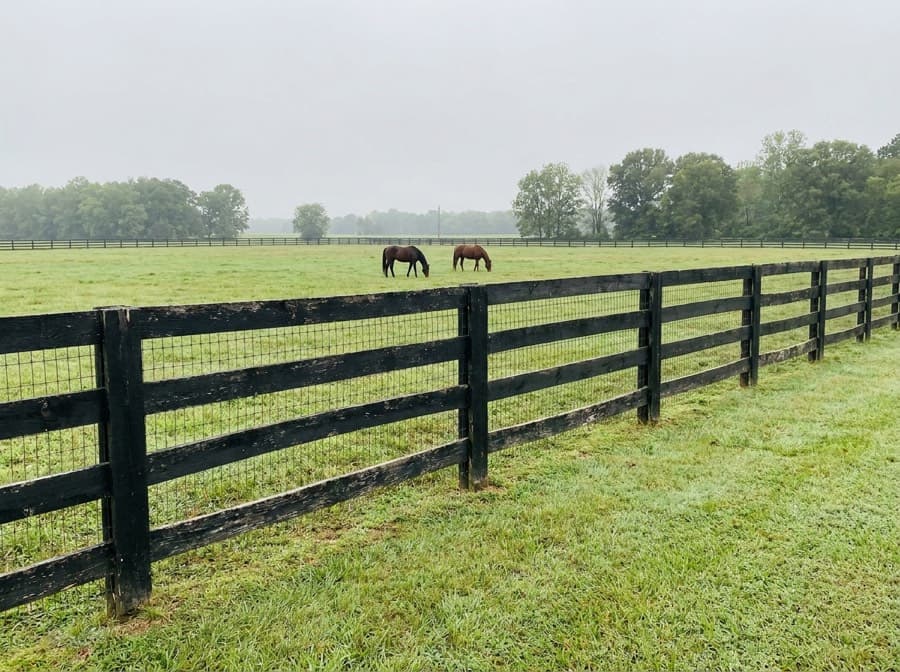
The combination build: 2x4 no-climb mesh under a top board. Visibility and bite protection up top, hoof safety below.
Pasture cross-fencing
Coated or plain electrified high-tensile dividing larger horse pastures where budget per foot matters.
Jacksonville, NC considerations
Horse properties in our area run from small two-stall setups outside Jacksonville to working farms toward Richlands, Kenansville, and the Duplin County line. Sandy soil means posts want extra depth and concrete at gates and corners, and coastal storms argue for wire that flexes and boards that can be replaced a rail at a time. If the horses share ground with cattle or goats, we'll spec the runs separately — what's right for the herd is usually wrong for the horse.
What drives horse fencing pricing
We don't post exact prices because every project is different. These are the factors that matter most when we work up an estimate.
Electrified high-tensile costs the least per foot, no-climb mesh sits in the middle, and board fence — especially four-board — costs the most.
Three-board vs four-board changes lumber, labor, and the look. Four-board reads more formal and contains better.
Mesh plus top board costs more than either alone but does both jobs — most paddock quotes end up here.
Board fence wants 8' spacing; mesh runs allow wider. Tighter spacing means more posts per hundred feet.
Stall-area walk gates, drive gates, and trailer access each add braced openings.
Fencing a paddock or pasture?
Tell us about the horses, the acreage, and the look you want. We'll walk it and quote it by the foot.
Questions worth asking
- 1How many horses, and do any of them test or crib the fence?
- 2Paddock, perimeter pasture, or both?
- 3Do you want the board look, maximum hoof safety, or the combination?
- 4Where do trailers and equipment need to get in?
- 5Any foals — and if so, does the mesh need to be foal-tight?
Our process
- 1
Walk the property
Terrain, existing fence, and how the horses actually use the space decide more than the catalog does.
- 2
Spec horse-safe
Fence type, heights, and gate plan in a written per-foot quote — nothing barbed, nothing a hoof fits through.
- 3
Build
Corners and gate posts set first (concrete where the soil asks for it), then line posts, mesh stretched, boards last.
Helpful guides before you build
Short, specific reads tied to this kind of project.
Planning Farm and Pasture Fencing in Onslow County
How acreage changes fence math: matching fence to animal, gate sizing, brace posts, wet ground, and NC 811.
Read guide →Fence Cost in Jacksonville, NC
What actually drives fence cost in Jacksonville — materials, length, gates, terrain, HOA rules.
Read guide →Why Fence Posts Fail in Sandy Coastal Soil — and How to Set Them Right
Sandy Onslow County soil doesn't grip posts like clay — what proper depth, footings, and drainage look like here.
Read guide →Related fence services
Other fence services in Jacksonville, NC that may be relevant for your property.
Farm Fence Installation
Field fencing, barbed wire, high-tensile, woven wire, and ranch-rail for working farms across Duplin, Sampson, Lenoir, Wayne, Craven, and Onslow counties.
View →Woven Wire & Field Fence Installation
Field fence, fixed-knot, and woven mesh stretched tight on braced corners — the workhorse fence of eastern NC farms.
View →Wood Fence Installation
Pressure-treated pine and cedar-look builds — privacy, picket, shadow box, and ranch styles.
View →Gate Installation
Walk gates, double gates, driveway gates, and matching gates for any fence type.
View →Horse Fencing across Onslow County and nearby NC communities
We work across Jacksonville and the surrounding area. See the area page for local context.
Jacksonville, NC
Home market — residential, commercial, and military-family fencing across Jacksonville's neighborhoods.
Richlands, NC
Rural and small-town fencing — privacy, ranch, and farm builds across Richlands and the surrounding countryside.
Sneads Ferry, NC
Coastal fencing — privacy, vinyl, and aluminum builds for Sneads Ferry homes near the water.
Swansboro, NC
Coastal-town fencing for homes, marinas, and small businesses in and around Swansboro.
Onslow County, NC
County-wide service — residential, commercial, and farm fencing across Onslow County.
Hubert, NC
Suburban fencing for Hubert residents — privacy, wood, and vinyl builds on residential lots.
Holly Ridge, NC
Residential and coastal-adjacent fencing for Holly Ridge homeowners.
Maysville, NC
Rural and farm fencing — pasture, ranch, and privacy builds for Maysville and Jones County properties.
Frequently asked questions
What is no-climb horse fence?
Woven wire mesh with 2x4-inch openings — too small for a hoof to pass through and too tight to climb. It's the standard for horse safety, usually run 48 to 60 inches tall on wood posts, often with a top board or electric offset for visibility.
Why can't I use barbed wire for horses?
Horses spook, bolt, and lean in ways cattle don't, and barbed wire causes exactly the kind of injury a horse can't afford. Every equine authority — and most insurers — say no barbed wire for horses. We won't build it.
Is board fence alone safe for horses?
Board fence is horse-safe and looks the part, but boards alone won't stop a horse from reaching through or a dog from getting in. The board-with-mesh combination solves both, which is why so many paddocks end up there.
What about electric fencing for horses?
Electrified tape, rope, or coated high-tensile works well for pasture and cross-fencing because horses see it and learn it fast. We'd hesitate to make plain thin wire the only barrier on a perimeter — visibility is the whole game with horses.
How tall should a horse fence be?
54 to 60 inches for most horses; 48 inches can work for small, settled groups. Stallions, fence-testers, and shared property lines argue for the taller end.
Ready to request horse fencing pricing?
Use the estimate form above or give us a call — we'll come back with next steps.