
How Long Does a Fence Last in Coastal North Carolina?
Ask three fence contractors how long a fence lasts and you'll get three confident answers, all suspiciously round. In Jacksonville and coastal Onslow County the honest answer is a range — and the coastal part matters, because salt air, sandy soil, humidity, and tropical-storm season all shave years off the textbook numbers. So: how long does a fence last here, really? Here's the material-by-material answer, plus what kills fences early and what buys them extra years.
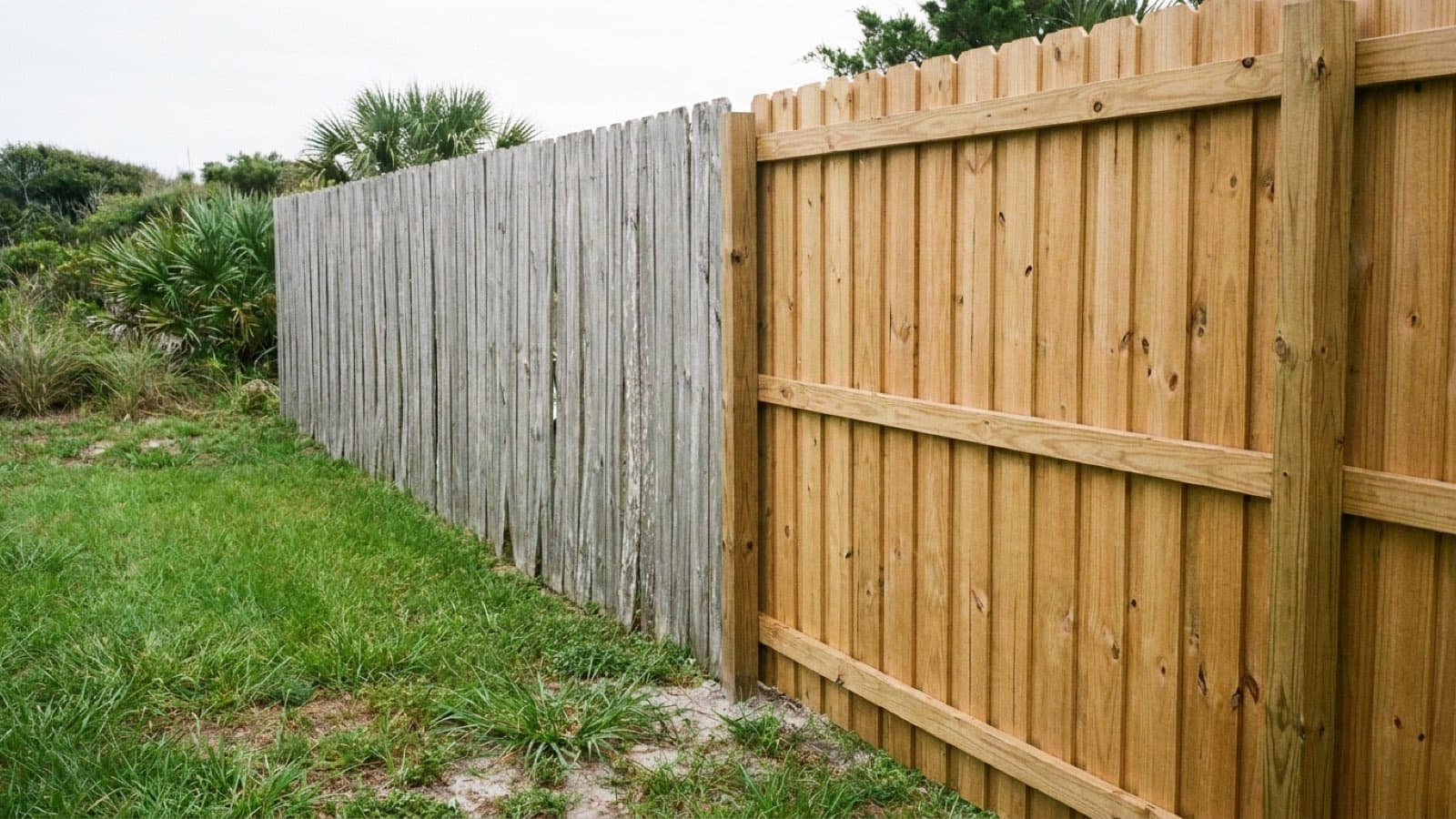
How long does a fence last here? The short answer
Rough, honest ranges for coastal Onslow County: pressure-treated pine, 12 to 20 years, with the posts usually deciding which end of that range you get. Cedar boards a bit longer than pine, same post problem. Quality UV-stabilized vinyl, 25-plus years. Galvanized chain link, 15 to 20 near the water and longer inland. Aluminum, decades, as long as the coating stays intact.
Notice every one of those is a range, not a number. The spread comes from three things: how close you are to salt air, how well the fence was built, and whether anyone maintained it. The national averages you'll find online assume a milder climate and an average install. Around here, both assumptions are optimistic.
Pressure-treated pine: the posts fail first
The most common fence in Jacksonville is a 6-foot pressure-treated privacy fence, so let's be specific about how it dies. It's almost never the boards. Pickets and rails can look rough — gray, a little cupped — and still have a decade of structural life left. The failure point is the posts, right at the ground line, where moisture, oxygen, and soil meet. That few inches of post rots from the inside while everything above it still looks fine, and it typically gives out years before the boards do.
Coastal humidity makes this worse because the wood simply spends more of the year wet. A well-set pressure-treated fence here can push past 15 years; a poorly set one can start leaning at 8. Same lumber, very different outcome — more on that below.
Cedar: nicer boards, same ground-line problem
Cedar's natural oils resist rot and insects, and cedar pickets will generally outlast pine pickets side by side. What cedar doesn't fix is the post problem — most cedar fences around here are built on pressure-treated posts anyway, because cedar in direct ground contact in our wet sandy soil is not a bet we'd make. So the fence's real lifespan is still set by the posts.
Cedar also isn't maintenance-free in this humidity. Skip the seal cycles and it grays and checks like anything else. If you're paying the cedar premium, budget for the upkeep that protects it, or you're buying looks that last five years instead of fifteen.
How long does a vinyl fence last in salt air?
This is where vinyl earns its keep on the coast. Quality UV-stabilized vinyl doesn't rot, doesn't rust, and doesn't care about salt — 25-plus years is realistic, and plenty of vinyl fences will outlast the owner's time in the house, which matters in a PCS-heavy market like ours. Check the manufacturer's current warranty terms rather than taking anyone's word for a number, ours included.
Vinyl's real failure modes here are different: bargain panels that turn chalky and brittle in our UV after a decade, storm impacts that crack posts or blow out panels, and green mildew film on the shady north side — which looks alarming but washes off. Our wood-vs-vinyl guide digs into whether the upfront premium makes sense for how long you'll own the property.
Chain link: galvanized vs. vinyl-coated near the coast
Galvanized chain link is tough, but the zinc coating is sacrificial — it slowly gives itself up protecting the steel underneath, and salt air speeds that up considerably. Near the water, expect rust to show at the fittings, tension wire, and the bottom of the fabric years earlier than the same fence would inland. Call it 15 to 20 years coastal, longer in Richlands than in Sneads Ferry.
Vinyl-coated chain link adds a plastic barrier over the steel and is the better coastal pick: the coating blocks salt from ever reaching the metal, so the fence's life stretches meaningfully. The weak points become the spots where the coating gets nicked — gate hardware, tie wires, anywhere a trimmer chews it.
Aluminum: decades, if you protect the coating
Ornamental aluminum is the long-haul metal for coastal NC because it doesn't rust the way steel does. The powder coating is doing the protective work, and as long as it stays intact, the fence lasts decades. That's why aluminum is the default around pools and in front yards from Swansboro to Holly Ridge.
The thing to watch is coating damage: a deep scratch from a mower or a trimmer opens bare aluminum to salt air, and you'll get white oxidation and pitting at that spot. Fasteners and gate hardware are the other usual weak points. Touch up scratches, rinse it near the coast, and there's not much else it needs.
What shortens fence life in coastal Onslow County
Salt-air proximity is the big one, and it's a gradient, not a switch. A fence in North Topsail Beach or Surf City lives a measurably harder life than the same fence in Richlands or Maysville — the difference shows up first on metal parts and coatings, and it's measured in years, not months. Sneads Ferry and anything near the New River estuary sit in between.
Sandy soil is the quiet killer: it drains fast, which is good for rot, but it doesn't grip posts the way clay does, so posts loosen and wiggle under wind load, and every storm makes it worse. Speaking of storms — a 6-foot privacy fence is a sail, and tropical-storm wind finds every marginal post. Two slower killers round out the list: mildew on the shaded side of a fence keeps wood damp for weeks at a time, and a sprinkler head that soaks the same fence section every morning will rot a band of pickets years ahead of the rest of the run. Aim the sprinkler somewhere else.
What actually extends a fence's life
Four things, in order of impact. First, proper post setting — depth, footing size, and drainage matched to sandy soil. This is decided on day one and you can't retrofit it. Second, stain or seal wood on a real cycle, every two to three years, not once at install and never again. It won't save the posts below grade, but it meaningfully extends boards and rails.
Third, if you're within a couple miles of salt water, rinse the fence with fresh water now and then — especially metal fences and hardware. It's free and it works. Fourth, fix small problems fast. A leaning post re-set this year is a small job; ignored, it loads its neighbors and next year you're replacing a whole run. Fence problems compound like that — early repairs are the cheapest years you can buy.
The install-quality multiplier
Here's the part most lifespan articles skip: the same material lasts wildly differently depending on the crew that set it. Posts set 24 inches deep instead of a proper depth for the height, dry concrete bagged into the hole and left to "find water," non-galvanized fasteners that bleed rust streaks in a year, pickets run tight to grade so they wick water off the ground — every one of those quietly subtracts years, and none of them are visible in a finished-fence photo.
A carefully built pressure-treated fence can genuinely outlast a badly built vinyl one. When you're comparing quotes, ask how deep the posts go, what the footing spec is for sandy soil, and what fasteners they use. The answers tell you more about lifespan than the material brochure does.
When to stop repairing and start planning a replacement
Every fence hits a point where repairs are chasing each other. Our repair-vs-replacement guide covers the full decision, but the short version: if failing posts are scattered across the whole fence rather than clustered in one spot, if the wood is too brittle to hold new fasteners, or if you've repaired the same run twice in two years, you're paying replacement money on an installment plan.
One or two bad posts on an otherwise sound fence? Repair it — that's a normal service call, and if it's a single loose picket, honestly, it's a 15-minute job you can do yourself. But when more than roughly a quarter of the posts are compromised, the math flips, and we'll tell you so rather than sell you another round of patches.
Want a real fence estimate?
Send a few project details and we'll come back with next steps. Most details are optional — share what you can.
- Tap your fence type and rough length
- Name and phone — email optional
- We follow up to talk through the project
- Written pricing after we measure on-site
Prefer to talk it through?
(910) 708-9268No pressure — we’ll follow up to learn about your project and the next steps.

What kind of fence are you looking at?
Pick the closest — we'll talk details when we follow up.
Frequently asked questions
How long does a wood fence last in Jacksonville, NC?
Realistically 12 to 20 years for pressure-treated pine, with posts failing at the ground line before the boards wear out. Install quality and whether anyone ever stained it decide which end of that range you land on.
Do fences really wear out faster near the beach?
Yes, and it's not subtle. Salt air attacks metal parts, coatings, and fasteners first, so a fence in Surf City or North Topsail Beach ages years faster than the same fence in Richlands. Rinsing with fresh water and choosing coastal-appropriate materials narrows the gap.
Does staining a fence actually extend its life?
For the boards and rails, yes — a stain or seal cycle every two to three years is the single best thing you can do for wood above grade in this humidity. It won't save posts below the ground line, which is where most wood fences fail first.
Which fence material lasts longest in coastal North Carolina?
Quality vinyl and powder-coated aluminum both run decades here and shrug off salt air better than anything with exposed steel or untreated wood. But a well-built wood fence beats a badly built anything — install quality moves lifespan more than the material choice does.
Can a fence survive a hurricane?
No fence is storm-proof, and we won't pretend otherwise. Solid privacy fences catch wind like a sail, so post depth and footing quality are what decide whether you lose a picket or a whole run. After a storm, fix leaning posts quickly — a loosened post that survives one storm often fails in the next.
Browse related fence services
Specific services in Jacksonville, NC that connect to this article.
Fence Installation
New fence builds across Jacksonville and Onslow County for homes, businesses, and farms — built to handle coastal NC conditions.
Learn more →Fence Repair
Storm damage, leaning posts, broken panels, and gate problems — we patch, replace, or rebuild only what needs it.
Learn more →Vinyl Fence Installation
Low-maintenance privacy, picket, and ranch vinyl fencing built to handle coastal humidity and salt air.
Learn more →More from Jacksonville Fence Company
Wood vs Vinyl Fence in Jacksonville, NC
Coastal humidity, maintenance, cost, look — wood vs vinyl compared honestly for the Jacksonville market.
Fence Repair vs Replacement in Jacksonville, NC
When to patch and when to rebuild — for storm damage, rotten posts, broken panels, and gate sag.
Why Fence Posts Fail in Sandy Coastal Soil — and How to Set Them Right
Sandy Onslow County soil doesn't grip posts like clay — what proper depth, footings, and drainage look like here.
Staining and Sealing a Wood Fence in Coastal North Carolina
When new pressure-treated wood is actually ready, the water-bead test, stain types without the hype, and the coastal 2-3 year cycle.
How to Clean a Vinyl Fence in Coastal North Carolina
Hose, soft brush, mild soap — plus the fix for coastal NC's green-algae problem and the few things that actually damage vinyl.
Want a straight answer on how much life your fence has left?
Send us a few photos or have us walk the line. We'll tell you what's worth repairing, what's near the end, and what we'd build if it were our yard — a real fence quote, no high-pressure pitch.