
How to Prepare Your Fence for Hurricane Season in Jacksonville, NC
Hurricane season runs June through November, and in Jacksonville, NC that isn't an abstract date range — it's the stretch of the year when your fence either proves it was built right or shows you where it wasn't. Most of the hurricane fence damage we see was preventable: a post that was already loose, a hinge that was already sagging, a dead limb that should have come down two summers ago. Here's how to prepare your fence for hurricane season the way we'd prep our own — plus what to do in the days before a named storm and after one passes through.
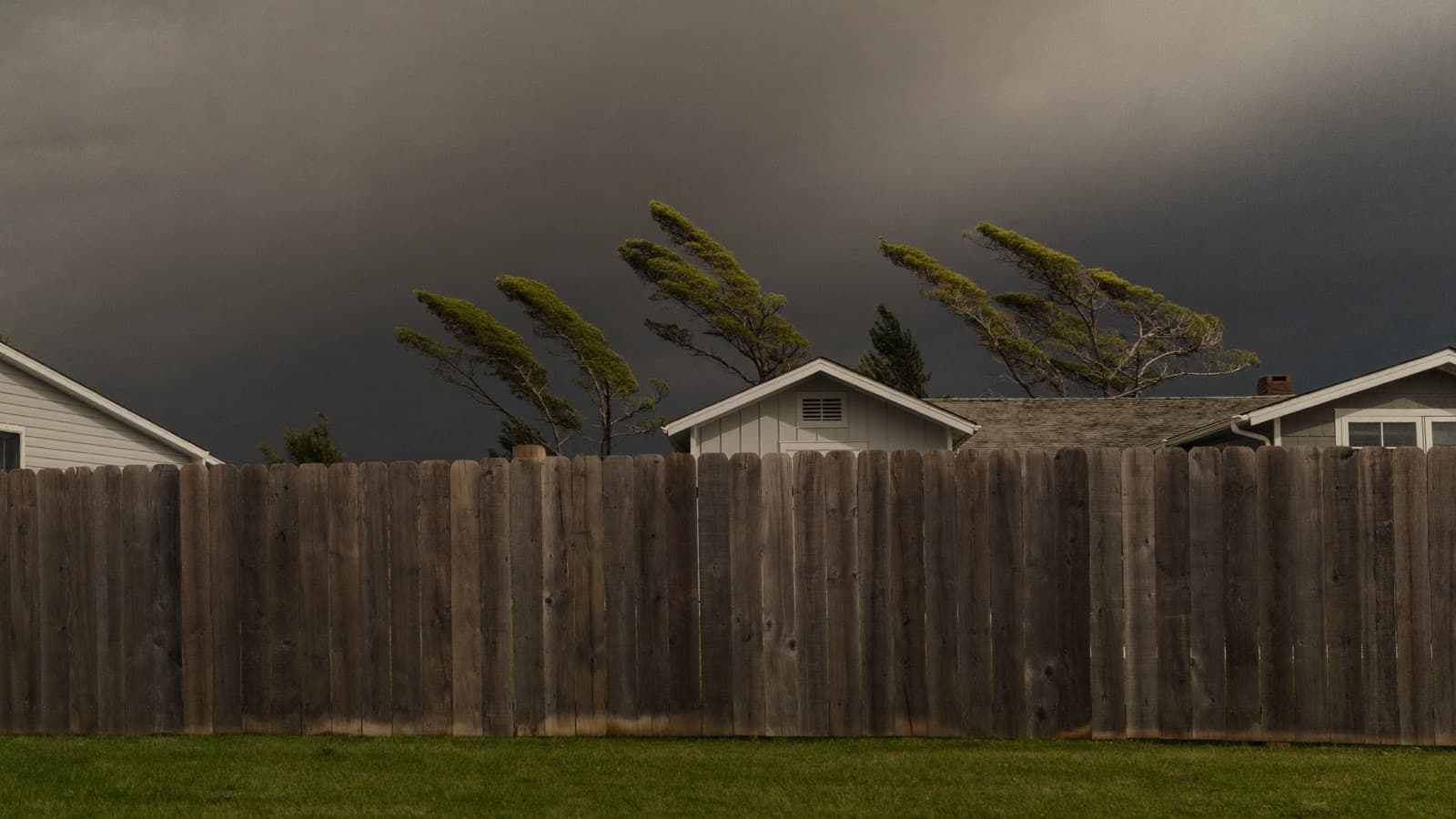
Why preparing your fence for hurricane season matters in Onslow County
Coastal Onslow County sits in the path of anything that curves up the Atlantic seaboard, and a fence doesn't need a direct hit to take damage. A tropical storm passing offshore can put hours of gusts on a fence line while dumping enough rain to saturate the sandy soil holding the posts. Sustained wind load on wet, loosened ground is how most storm fence damage happens in Jacksonville, Hubert, Sneads Ferry, and the beach communities from Surf City up through North Topsail.
The good news is that the failures are predictable. Fences almost never blow apart at random — they fail at the weakest post, the rustiest hinge, or under the limb that was already dead. A pre-season walkthrough finds those weak points while they're still cheap to fix.
The push test: find loose posts before the wind does
Walk the fence line and push on every post — hand at chest height, firm steady pressure in both directions. A solid post barely moves. A post that rocks at the ground line has lost its grip on the soil, and around here that's common: sandy soil doesn't clamp back around a post the way clay does, so once a post starts working, every windy afternoon wallows the socket out a little more.
The post that moves an inch on a calm day in June is the post that leans over in a named storm — and when one post goes, it usually takes the panels on both sides with it. Resetting a few loose posts in early summer is a modest repair. Rebuilding forty feet of blown-down fence in September is not.
Probe the ground line — that's where wood fences actually break
Wood posts don't rot evenly. The failure zone is the few inches right at grade, where soil contact, moisture, and oxygen all meet. Take a screwdriver and probe each post at the ground line: solid wood pushes back, rot feels soft and spongy. A post can look healthy at eye level while it's down to half its real thickness where it matters.
Wind load tests a post exactly at that point — the ground line is the fulcrum. If you find soft posts, make the repair call before August, not after. Our guide on fence repair versus replacement walks through when a few bad posts are a straightforward fix and when they're a symptom of a fence at the end of its run.
Tighten hardware while it's still a screwdriver job
Salt air and humidity chew on fence hardware year-round. Before the season, go down the line and snug every rail bracket, refasten pickets that have popped, and replace anything rusted through instead of tightening around it. On gates, check the hinge lag screws — a sagging gate works its own hardware loose, and loose hardware is what lets panels start slapping in the wind.
A fence that rattles on a breezy day is telling you where it will fail in a real blow. A handful of exterior screws and an hour with a driver fixes most of it. This is the highest-return hour of storm prep there is.
Trim the limbs that are aimed at your fence
Falling limbs cause more storm fence damage than wind alone. Walk the line and look up: dead limbs, long overhangs, and pines or water oaks leaning toward the fence are all candidates. Trim back what you can reach safely from the ground, and get deadwood out of any tree standing over the fence.
Big removals near power lines or over structures are tree-service work — that's not us, and it's not a DIY ladder job either. But a morning of trimming costs a fraction of replacing crushed panels, and unlike wind, a limb strike takes out rails and pickets no matter how well the posts were set.
Gates: the moving part fails first
A gate is the only part of your fence designed to move, which makes it the first thing wind exploits. Check that the latch actually catches with authority — not a light click a gust can bounce open. Double gates need their drop rods seating fully into the ground sleeve, not resting on top of packed sand. Fix sag now: a dragging gate that barely latches in July will not stay latched in a storm.
Once a gate blows open, it slams through hundreds of cycles an hour, hammering the hinges and the latch post until it tears itself loose — at which point it becomes a projectile in your yard or your neighbor's.
The days before a named storm: what's actually worth doing
When a storm gets a name and a cone that includes Onslow County, the useful list is short. Latch every gate shut, drop the rods, and tie gates off so they can't swing — closed and secured beats open every time, because movement is what destroys hinges. Pull off decorative post caps, solar lights, string lights, planters, and anything else hanging on the fence; small attachments become small projectiles. Move trampolines, patio furniture, and trash cans well away from the fence line — a lot of the fence damage we repair after storms was caused by someone's flying furniture, not the wind itself.
Then take photos: wide shots down every run, close-ups of gates and corners, with dates. Ten minutes now gives you a clean before picture if you end up filing a claim.
What NOT to bother with
A few things people do before storms that aren't worth the effort or the risk. Don't unscrew panels or take sections down — a sound fence handles wind better standing than a stack of loose panels handles becoming airborne. Don't wrap the fence in tarps or plywood; you're adding sail area, not protection. Don't pour concrete around a wobbly post two days out — it won't cure into anything useful in time, and a temporary diagonal brace screwed to a stake does more. And don't get on a ladder to trim limbs with a storm inbound.
If the fence is sound, pre-storm prep is a twenty-minute job. The real work happens in June, not the day the cone shows up.
After the hurricane: triage, photos, and two written estimates
First rule: if any power line is down on or near your fence, stay away and call the utility — a fence can carry current well down the line, especially chain link. Once it's safe, walk the fence before you touch anything and photograph everything: wide shots, close-ups, standing water, the tree on the fence. Document first, clean up second — adjusters want to see the damage as the storm left it.
For insurance, get two written estimates: one to repair, one to replace. The pair lets the adjuster compare real numbers instead of guessing, and it protects you from being pushed into a patch job on a fence that's actually totaled. We provide both from a single visit — that's normal practice for us after storms, not a special favor. Keep receipts for any emergency work like tarping or bracing.
When the storm just finished what time started
Some of the fences we get called about after a storm weren't really destroyed by the storm — the storm just collected a fence that was already at the end of its life. Fifteen-year-old pine posts rotted at the ground line were coming down eventually; the wind picked the date. In that case, putting money into resetting rotten posts is throwing good money after bad, and we'll tell you so.
If you end up replacing rather than repairing, the rebuild is a chance to fix what the old fence got wrong — deeper post settings for our sandy soil, better hardware, a gate placed where you actually use it. Depending on the scope, permit questions can enter the picture; our fence permits guide covers the common pattern, and it's worth confirming with the City of Jacksonville or Onslow County before the rebuild.
Want a real fence estimate?
Send a few project details and we'll come back with next steps. Most details are optional — share what you can.
- Tap your fence type and rough length
- Name and phone — email optional
- We follow up to talk through the project
- Written pricing after we measure on-site
Prefer to talk it through?
(910) 708-9268No pressure — we’ll follow up to learn about your project and the next steps.

What kind of fence are you looking at?
Pick the closest — we'll talk details when we follow up.
Frequently asked questions
Should my gate be open or closed during a hurricane?
Closed, latched, and tied off so it can't move. The damage comes from movement — a swinging gate hammers its hinges and latch post until something gives. Drop rods down, latch engaged, and a rope or ratchet strap as cheap insurance.
Will homeowners insurance cover hurricane fence damage?
That depends entirely on your policy — fences are often covered under other-structures coverage, sometimes with a separate wind or named-storm deductible. We can't read your policy for you, but we can supply what adjusters ask for: dated photos plus written repair and replacement estimates.
Can a wood privacy fence really survive hurricane winds?
A well-built one with sound posts rides out tropical-storm wind routinely. A direct hurricane hit is another matter — no honest contractor guarantees a fence against that. The point of prep is to remove the weak links so the wind finds nothing already loose.
Should I take fence panels down before a big storm?
Generally no. Dismantling a sound fence risks damaging it, and stored panels have to go somewhere windproof. The exception is a panel that's already loose or broken — secure or remove anything that's halfway to being a projectile before the storm makes it one.
How fast can you look at my fence after a storm?
After a big storm we triage — safety issues and loose-pet situations first. Sending photos with your estimate request speeds everything up. And a word of caution: be careful with out-of-town crews door-knocking for cash deposits after storms. Local companies will still be here in six months; storm chasers won't.
Browse related fence services
Specific services in Jacksonville, NC that connect to this article.
Fence Repair
Storm damage, leaning posts, broken panels, and gate problems — we patch, replace, or rebuild only what needs it.
Learn more →Fence Installation
New fence builds across Jacksonville and Onslow County for homes, businesses, and farms — built to handle coastal NC conditions.
Learn more →Wood Fence Installation
Pressure-treated pine and cedar-look builds — privacy, picket, shadow box, and ranch styles.
Learn more →More from Jacksonville Fence Company
Fence Repair vs Replacement in Jacksonville, NC
When to patch and when to rebuild — for storm damage, rotten posts, broken panels, and gate sag.
Do You Need a Fence Permit in Jacksonville, NC?
The straight answer for the city and the county — plus the height rules, property-line, HOA, and 811 steps that still apply.
Getting Your Deck Hurricane-Ready in Coastal North Carolina
Where decks actually fail in wind — and the pre-season checks and pre-storm steps that matter on the coast.
Why Fence Posts Fail in Sandy Coastal Soil — and How to Set Them Right
Sandy Onslow County soil doesn't grip posts like clay — what proper depth, footings, and drainage look like here.
How Long Does a Fence Last in Coastal North Carolina?
Honest lifespan ranges for wood, vinyl, chain link, and aluminum fences in coastal Onslow County — and what shortens or extends them.
Want your fence storm-ready before the season peaks?
Send a few photos and details and we'll tell you straight what needs fixing, what doesn't, and what it'll take — no high-pressure pitch.