
A Year-Round Deck Maintenance Calendar for Coastal North Carolina
Decks in coastal North Carolina rarely fail from one big event. They fail from small stuff nobody looked at — a clogged board gap, a planter that never moved, a loose railing post that got looser. A deck maintenance schedule turns the vague I-should-check-the-deck-sometime into a short, specific list for each season, and around Onslow County each season really does have its own job. Here's the calendar we'd hang on any deck in the area, wood or composite.
Why a deck maintenance schedule beats a someday list
Coastal decks age from three directions at once: humidity working on the wood, UV working on every surface, and salt air working on the metal holding it all together. No single season covers all three, which is why once-a-year-when-I-remember doesn't cut it here.
The good news is that none of the seasonal jobs below is a project. Most are an hour or less. The calendar exists so each one happens at the moment it matters — checking railings before the deck's busiest season, not after, and clearing board gaps after the leaves drop, not in March when they've been holding water against the boards all winter.
Spring: wash off the winter
Start with a wash, because you can't inspect what you can't see. Spring in Jacksonville means every outdoor surface wears that yellow pollen film, usually with some mildew shading the corners that stayed damp. Soapy water and a stiff broom or soft brush handle it; on wood, a careful low-pressure wash works if you keep the fan tip wide and moving.
Composite owners: yes, this includes you. Composite is low maintenance, not no maintenance — it doesn't rot, but it grows the same mildew film in our humidity and holds pollen just as well. A spring wash is the bulk of what it asks of you all year, which is a pretty good deal.
Spring: the once-over before grilling season
While the deck dries, walk it with a critical eye — this is the inspection before the season your deck works hardest. Grab every railing section and try to wobble it; a railing that gives should get fixed before the first cookout crowd leans on it. Check stairs for movement and stringers for cracks. Look for fastener heads sitting proud of the boards — popped screws and nails back out a little more every humid summer.
On wood decks, press a screwdriver into any board that looks dark or stays damp: solid wood pushes back, rot gives. Soft spots caught in April are a board swap; found in August under a loaded cooler, they're a worse afternoon.
Early summer: hurricane-season readiness
Hurricane season runs June through November, and the smart move is deciding things in June that you don't want to decide in the 72 hours before landfall. Know what leaves the deck when a storm gets a name: furniture, umbrellas, planters, grill — anything that becomes a projectile in tropical-storm wind. Know where it goes, and make sure it still fits there.
This is also the moment to check the connections that matter in wind: post bases, railing attachments, and stair connections. Our hurricane deck prep article covers the full storm checklist; the calendar's job is just making sure you've read it in June instead of searching for it while the cone map tightens on the New River.
High summer: UV, furniture, and the planter problem
July and August are when the sun does its damage — full UV, boards too hot to cross barefoot. There's no chore that stops it, but a few habits slow it down. Put pads under furniture feet: grit trapped under a chair leg grinds through finish every time the chair scoots. Shift furniture and rugs around occasionally so the deck weathers evenly instead of in silhouettes.
The silent one is planters. A pot sitting flat on the boards traps moisture underneath, and that damp circle never dries — on wood it becomes a rot ring, and even on composite it grows a stubborn mildew shadow. Set planters on pot feet so air moves underneath, and check the drainage isn't emptying straight onto the same board every day.
Fall: leaves and pine needles in the board gaps
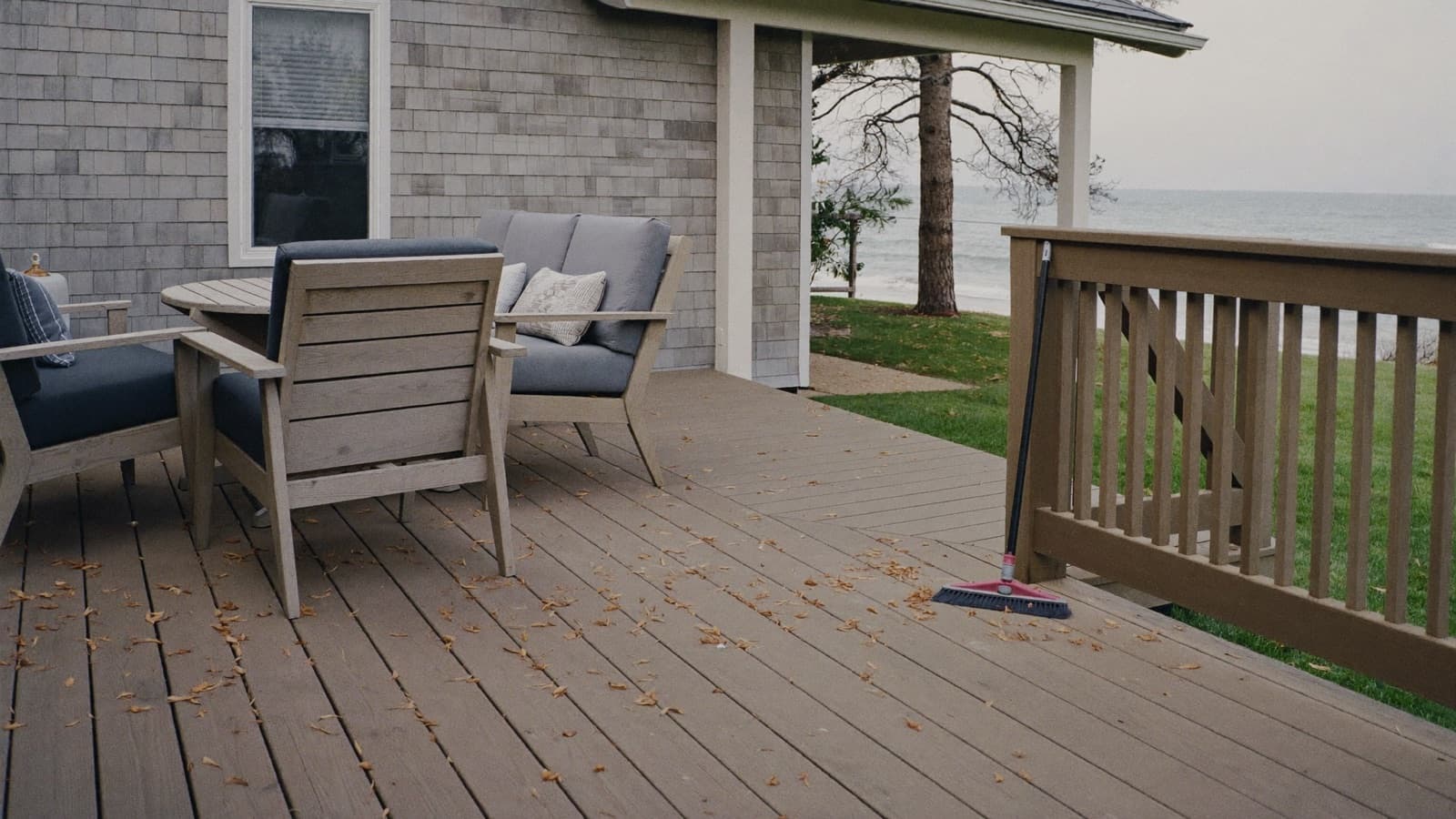
Fall is the highest-leverage chore on this list and the least glamorous. Around Onslow County, pine needles are the main offender — they mat down into the gaps between deck boards and pack in tight, holding moisture against the board edges all winter. Board edges and gaps are exactly where wood decks rot first.
Sweep or blow the deck, then clear the gaps: a leaf blower angled along the gaps gets most of it, and a putty knife handles what's packed in. Do it once when the pines drop and again after the oaks finish, and clear underneath the deck skirting while you're at it. Clogged gaps are the single most preventable moisture problem a deck around here has.
Fall: look up — gutters drain somewhere
The other fall job isn't on the deck at all. If a gutter runs above or alongside the deck, an overflow point becomes a waterfall that hits the same spot every rain, all winter. One concentrated drip line can do more damage to a section of decking than a whole season of weather spread evenly.
Clean the gutters, then step back during the next hard rain and watch where the water actually goes. A downspout aimed across deck boards or dumping beside a deck post is rearranging your deck's lifespan — and redirecting it is one of the cheapest fixes on this whole list.
Winter: the good news
Here's the part of coastal NC deck ownership that's genuinely easy: winter. Onslow County winters are mild — no snow load, no freeze-thaw punishment, no shoveling scars. Your deck mostly just sits there.
Which makes winter the working season for everything else. It's the best time to schedule repairs — lumber stays dry enough to work, and contractor calendars are open in a way they never are in May. It's also the season to plan a new build or a resurface so it's finished before spring: decks planned in January are grilling platforms by April, while decks planned in April join a queue. Families staring down a spring PCS out of Camp Lejeune, take note — a winter repair list is what makes the deck a selling point instead of an inspection finding.
Wood vs composite: how the calendar changes
Everything above applies to both materials. Wood adds one recurring project: the stain-and-seal cycle, every two to three years in our climate, plus more diligence with the screwdriver test since rot is on the menu. Our post on staining and sealing covers the timing and the water-bead test that tells you when it's due.
Composite drops the staining but keeps the washes, the gap-clearing, the hardware checks, and the hurricane prep — and remember that under most composite decks sits a pressure-treated wood frame, aging like wood does. If you're weighing the two materials for a future build, our composite-vs-wood decking guide walks through the real trade-offs, and the deck cost guide covers what moves the budget.
What a professional inspection catches that owners miss
An honest annual rhythm handles most of it, but some problems live where owners don't look. The ledger connection — where the deck bolts to the house — is the failure that actually drops decks, and judging it means knowing what the flashing behind it should look like. Post bases at grade rot from the inside and look fine until they don't. Joist hangers and fasteners under the deck corrode quietly, faster near the salt air of Sneads Ferry, Surf City, and North Topsail Beach than inland in Richlands.
Owners see the surface; the problems that matter live underneath. A professional inspection once a year — or before buying a house with an older deck — is cheap insurance, and most of what it finds early is a small fix. We do deck inspections, and if yours is showing symptoms already, our post on signs a deck needs repair is worth a look before anyone quotes you anything.
Want a real deck estimate?
Send a few project details and we'll come back with next steps. Most details are optional — share what you can.
- Tap your project type and material
- Name and phone — email optional
- We follow up to schedule the on-site visit
- Written pricing after we measure
Prefer to talk it through?
(910) 708-9268No pressure — we’ll follow up to learn about your project and the next steps.

What's the deck project?
One tap — we'll talk details when we follow up.
Frequently asked questions
Do composite decks need any maintenance?
Yes — less than wood, but not none. Composite still needs the seasonal washes to knock down pollen and mildew, board gaps cleared of pine needles, hardware and railing checks, and hurricane prep. What it skips is the stain-and-seal cycle and most rot worries on the walking surface. Low maintenance, not no maintenance.
How often should I wash my deck in coastal NC?
Twice a year as a baseline: spring, after pollen season, and fall, with the leaf cleanup. Shady decks and decks near the water usually want an extra rinse in mid-summer when the mildew film shows back up. Soapy water and a brush cover it — save the pressure washer for careful, low-pressure use on wood.
When should I re-stain a wood deck here?
When water stops beading on the surface, the finish is done — that's the water-bead test. In coastal NC that typically comes around every two to three years, sooner on decks in full sun. Horizontal surfaces fail faster than fences, so trust the test over the calendar.
What does salt air actually do to a deck?
Its main target is metal: fasteners, joist hangers, and railing hardware corrode noticeably faster within a few miles of the water — Sneads Ferry, Surf City, North Topsail. Near the coast, stainless or heavily coated hardware is worth the upgrade, and an occasional plain-water rinse of railings and hardware slows the film buildup.
How often should a deck be professionally inspected?
Once a year is a sensible rhythm for a deck past its first decade, and worth it at any age before a home purchase or sale. The inspection targets what owners can't easily see — ledger and flashing, post bases, the corrosion state of hangers underneath. Most problems found early are small fixes; the expensive ones are the ones that got years of head start.
Browse related deck services
Specific services in Jacksonville, NC that connect to this article.
Deck Staining & Refinishing
Deck staining, sealing, and refinishing across Jacksonville and Onslow County — bring a gray, weathered wood deck back and protect it from coastal moisture.
Learn more →Deck Repair
Deck repair across Jacksonville and Onslow County — board replacement, rot, loose railings, stair fixes, and the framing problems behind them.
Learn more →Deck Inspection
Deck safety inspections across coastal NC — we assess railings, boards, stairs, ledger, and posts before any repair or replacement.
Learn more →More from Jacksonville Fence Company
Composite vs. Wood Decking in Jacksonville, NC
Up-front cost, maintenance, lifespan, heat, and looks — wood vs. composite decking compared for the coastal Jacksonville climate.
How Much Does a Deck Cost in Jacksonville, Maysville & Coastal NC?
The real drivers of deck pricing in Jacksonville — size, material, railings, stairs, demo, and permits — and why a per-project estimate beats a flat number.
10 Signs Your Deck Needs Repair — or a Professional Inspection
Soft boards, wobbly rails, rusted hangers, ledger trouble — the ten signs to check and when to call a pro.
Getting Your Deck Hurricane-Ready in Coastal North Carolina
Where decks actually fail in wind — and the pre-season checks and pre-storm steps that matter on the coast.
Staining and Sealing a Wood Fence in Coastal North Carolina
When new pressure-treated wood is actually ready, the water-bead test, stain types without the hype, and the coastal 2-3 year cycle.
Want a professional set of eyes on your deck?
The seasonal list is all yours — most of it takes an hour and a broom. But if the screwdriver test found something soft, the railing wobbles, or the deck is old enough that nobody's ever looked underneath, we'll come take a look and tell you straight what it needs and what it doesn't. Free estimate, no high-pressure pitch.