10 Signs Your Deck Needs Repair — or a Professional Inspection
Most decks around Jacksonville don't need to be torn down — they need a fastener-and-board tune-up before small problems become structural ones. But coastal humidity, salt air, and sandy soil do age a deck faster here than inland, so it pays to know the signs your deck needs repair and which ones mean stop guessing and get a professional inspection. Here are the ten we check first, in roughly the order homeowners notice them.
Sign 1: Soft or spongy boards underfoot
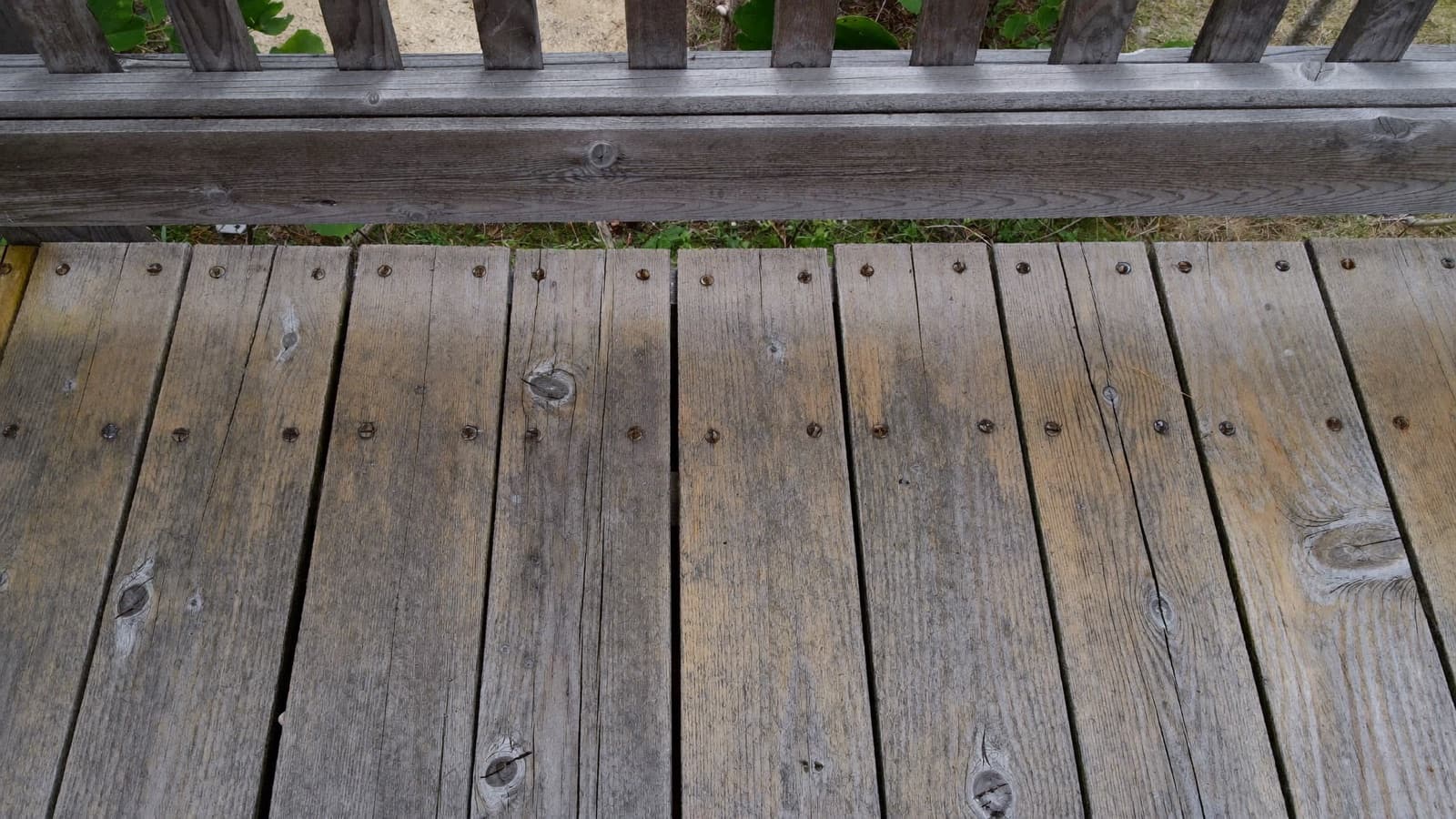
If a deck board gives under your heel like a stale cracker, that's rot — moisture has gotten past the wood's defenses, and in our humidity it doesn't reverse. The DIY check is simple: press suspect boards with a screwdriver tip. Sound wood resists; rotten wood takes the tip with almost no effort.
A few soft boards on an otherwise solid deck is a board-swap, not a crisis. The question that decides whether it's a DIY fix or a call to us: is the softness only in the walking surface, or has it reached the joists underneath? Lift a board or look from below. Soft joists move this from a Saturday project to a structural repair.
Sign 2: Rot at the ground line of your posts
Support posts rot where they meet the ground — right at grade, where moisture, soil, and air all meet. It's the classic failure point in sandy coastal soil, and it hides in plain sight because the post above it looks fine. Probe each post at ground level with a screwdriver, all the way around.
A post that's soft at the base isn't holding what it's supposed to hold, and this one is a call-a-pro item: replacing a structural post means temporarily supporting the deck, and the fix often includes getting the new post up out of ground contact on a proper footing and bracket so the problem doesn't repeat.
Sign 3: A wobbly railing — the one people ignore and shouldn't
Everyone has a relative who steadies themselves on the deck rail every time they take the stairs. A railing that moves when you lean on it has already failed at its one job; it just hasn't been asked to prove it yet, and the person most likely to ask is a kid or a grandparent.
Grab every rail section and push hard. Movement usually traces to the post-to-frame connection — loosened bolts, corroded hardware, or rot where the post attaches. Sometimes the fix is genuinely fifteen minutes with a wrench, and if so, do it yourself today. If the post moves because the wood around the connection is soft, that's a repair call. Either way, don't leave this one on the list.
Signs 4 and 5: Popped fasteners and rusted joist hangers
Nails backing out of deck boards are the deck equivalent of gray hairs — normal aging, as boards expand and contract through our humid summers and mild winters. A handful of proud nail heads is a tune-up: drive them, or better, replace them with proper deck screws. Dozens across the deck suggest the boards and frame are moving more than they should.
The related sign lives underneath: joist hangers and structural fasteners with rust on them. Salt air accelerates this badly — hardware that lasts decades inland can corrode much faster near the water in Sneads Ferry or North Topsail Beach. Surface rust on a few hangers is worth monitoring; flaking, scaling rust or hangers with missing fasteners means the metal holding your frame together is quietly retiring, and a pro should look.
Sign 6: Ledger board separation — take this one seriously
The ledger is the board that attaches the deck to your house, and ledger failure is the failure mode that drops decks — when you read about a deck collapsing during a cookout, the ledger connection is the usual suspect. Any visible gap between the ledger and the house, a deck that feels like it tilts away from the wall, or fasteners you can see backing out of the ledger: stop diagnosing and get it inspected.
We're not saying this to scare you — most ledgers we inspect are fine or need reinforcement, not surgery. But this is the one item on this list where guessing wrong has the worst downside, and an inspection settles it definitively.
Sign 7: Flashing failures and water stains at the house connection
Flashing is the metal or membrane that routes rainwater away from the ledger connection. When it's missing, damaged, or was never installed right, water runs down behind the ledger — rotting the ledger from the back, and often the house's rim board and siding with it. This is how a deck problem becomes a house problem.
Look for water staining on the siding below the deck connection, dark streaks at the ledger, or soft trim near the door. Coastal rain patterns and the occasional tropical system push a lot of water at that joint. Flashing repair itself is modest work; the reason to act early is what the water is doing where you can't see it.
Signs 8 and 9: Cracked posts, and telling mildew from rot
Wood cracks as it dries — the long surface splits called checking are cosmetic and nearly universal on pressure-treated lumber here. What's not cosmetic: deep cracks in structural posts that pass through the center, run near a connection point, or that you can fit a coin into. Surface checking is character; a through-crack in a load-bearing post is a repair.
Similar deal with discoloration. Mildew is a surface tenant — green or black film that washes off with a cleaner and leaves sound wood behind. Rot is a structural tenant — the wood underneath is dark, soft, and fibrous, and cleaning doesn't change what a screwdriver finds. In our humidity every shaded deck grows some mildew; wash it and move on. It's the soft wood underneath that goes on the repair list.
Sign 10: Sagging or bouncy spans
Stand at the edge of the deck and sight across the surface: it should read flat. A visible dip means a joist or beam is failing or was undersized to begin with. Bounce is the same story in motion — a deck that trampolines when two people walk across it is telling you the framing is overspanned, undersized, or compromised.
Some bounce in an older deck's longest span is common and fixable with added blocking or a mid-span beam — a modest repair that transforms how solid the deck feels. A sag that's visibly gotten worse season over season is a structural inspection, not a wait-and-see.
Repair or replace: how we actually make the call
Same honest logic we use on fences: it comes down to age and how widespread the problems are. A deck with a sound frame and scattered symptoms — some soft boards, tired fasteners, a loose rail section — is a repair, and a good one; you're buying years of life for a fraction of rebuild cost. A deck where the problems are structural and everywhere — rotting posts and a corroded frame and a suspect ledger — is a rebuild, because repairing it piecemeal means paying rebuild money in installments while never having a fully sound deck.
The honest tell is the frame. Boards and railings are replaceable finish; if the bones are good, almost everything else is fixable. Our deck cost guide covers what drives the numbers in each direction, and if you're weighing materials for a rebuild, our composite vs. wood guide is the place to start.
PCSing from Lejeune, or buying near it? Inspect the deck first
Two Jacksonville-specific reasons to get a deck professionally inspected on a schedule that isn't yours: moving out and moving in. If you're PCSing from Camp Lejeune or New River and the house is going up for sale or back to a property manager, a pre-move-out inspection turns deck surprises into a short punch list you control — instead of a repair negotiation you don't. And if you're buying here, the general home inspection often gives the deck a walk-across and a glance; a deck-specific look at the ledger, posts, and hangers is cheap diligence on the piece of the house most likely to have been built by a previous owner on a weekend.
Either way, most inspections end with a tune-up list, not a bombshell. That's the point of doing them early.
Want a real deck estimate?
Send a few project details and we'll come back with next steps. Most details are optional — share what you can.
- Tap your project type and material
- Name and phone — email optional
- We follow up to schedule the on-site visit
- Written pricing after we measure
Prefer to talk it through?
(910) 708-9268No pressure — we’ll follow up to learn about your project and the next steps.

What's the deck project?
One tap — we'll talk details when we follow up.
Frequently asked questions
How often should a deck be inspected in coastal NC?
Give it your own walkthrough every spring — probe the posts, shake the railing, look under the frame at the hangers and ledger. Salt air and humidity age hardware and wood faster here than inland, so a professional look makes sense every few years, after a major storm, or any time you find one of the structural signs: ledger movement, soft posts, or heavy hardware corrosion.
Are cracks in my deck boards a problem?
Usually not. Long surface splits from drying — called checking — are normal on pressure-treated lumber and are cosmetic. The cracks that matter are deep ones in structural posts or beams, especially near connection points. Board cracks bad enough to catch bare feet are a reason to swap boards, not to worry about the structure.
What does a professional deck inspection actually cover?
The structure, mostly: the ledger connection and its flashing, post bases and footings, joists and beams, hanger and fastener condition, railing strength, and stairs. The walking surface is the easy part — you can see that yourself. The value of a pro inspection is underneath, at the connections that fail quietly.
Does salt air really rust deck hardware that much faster?
Yes. Fasteners and joist hangers near the water corrode noticeably faster than the same hardware inland — it's why we spec stainless or heavily coated hardware close to the coast. If your deck is within a short walk of salt water and still has its original builder-grade hardware after many years, that's worth an inspection on its own.
My deck is 15 years old — does it automatically need replacing?
No. Age alone doesn't condemn a deck; condition does. We've inspected 20-year-old decks with sound frames that needed boards and hardware, and much younger decks with ledger problems that needed real work. The frame is the verdict — if the posts, joists, and ledger check out, a tune-up buys you years.
Browse related deck services
Specific services in Jacksonville, NC that connect to this article.
Deck Repair
Deck repair across Jacksonville and Onslow County — board replacement, rot, loose railings, stair fixes, and the framing problems behind them.
Learn more →Deck Inspection
Deck safety inspections across coastal NC — we assess railings, boards, stairs, ledger, and posts before any repair or replacement.
Learn more →Deck Replacement
Deck replacement and rebuilds across Jacksonville and Onslow County — tear out an aging wood deck and rebuild in wood or low-maintenance composite.
Learn more →More from Jacksonville Fence Company
Deck Permits in Jacksonville & Onslow County: Yes, You Need One — Here's What It Involves
Yes, decks need a permit here — what the application takes, the five inspections, and how we pull it for you.
How Much Does a Deck Cost in Jacksonville, Maysville & Coastal NC?
The real drivers of deck pricing in Jacksonville — size, material, railings, stairs, demo, and permits — and why a per-project estimate beats a flat number.
Composite vs. Wood Decking in Jacksonville, NC
Up-front cost, maintenance, lifespan, heat, and looks — wood vs. composite decking compared for the coastal Jacksonville climate.
A Year-Round Deck Maintenance Calendar for Coastal North Carolina
Season-by-season deck care for Onslow County — spring checks, hurricane readiness, fall cleanup, and what mild winters are good for.
Getting Your Deck Hurricane-Ready in Coastal North Carolina
Where decks actually fail in wind — and the pre-season checks and pre-storm steps that matter on the coast.
Trex vs. TimberTech: Picking Composite Decking for Coastal NC
Both brands work in coastal NC — here's the framework for choosing, and why the frame matters more than the logo.
Not sure if it's a repair or a rebuild?
Send us a few photos or book an inspection and we'll tell you straight — most decks we look at need a tune-up, not a teardown, and we'll say so when that's the case. No high-pressure pitch, just an honest read on the frame and a quote that matches what the deck actually needs.