Fence Etiquette: Neighbors, Property Lines, and Who Gets the Good Side
Most fence disputes don't start with the fence — they start with a conversation that never happened. Fence etiquette isn't law; it's the set of unwritten rules that keeps a one-week project from becoming a ten-year grudge. This post covers the ones that matter in Jacksonville, NC: who gets the good side of the fence, where the line actually is, how the money conversation usually goes, and what a good contractor does to keep all of it smooth.
Talk to your neighbor before you build — even though you usually don't have to
Let's be precise about this, because it gets misstated constantly: in most situations we see, building a fence on your own property doesn't require your neighbor's blessing. We're not lawyers and your HOA covenants may add their own notice rules — but as a general matter, this is etiquette, not obligation.
Do it anyway. Five minutes of "hey, we're putting up a fence along here next month" is the cheapest insurance in home improvement. It surfaces problems while they're still free to fix: a disputed line, a drainage pattern you didn't know about, a gate they were hoping for, a dog situation on their side. And it sets the tone. A neighbor who hears about the fence from you takes it fine; a neighbor who hears about it from a post-hole auger at 8 a.m. starts looking for things to object to.
Who gets the good side of the fence?
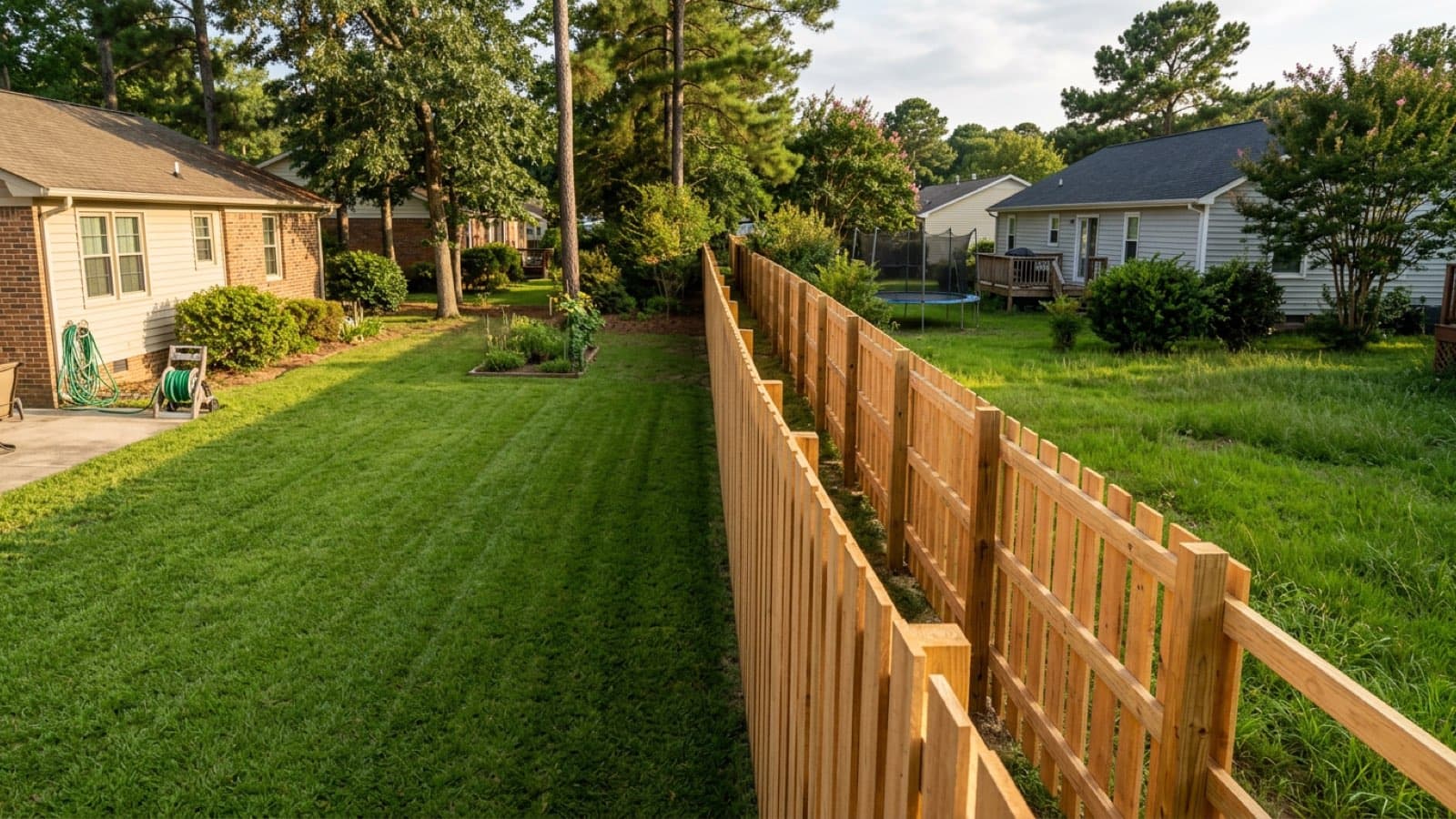
The convention, in Jacksonville and pretty much everywhere: the finished side faces out — toward your neighbor or the street — and the rails and posts face you. You're the one who wanted the fence, so you look at its bones and the rest of the world sees its face.
There are two good reasons beyond politeness. First, it reads as intentional; a fence with rails facing the street looks inside-out to everyone who drives past, including future buyers. Second, many HOAs don't leave it to convention at all — finished-side-out is written into a lot of local covenants, so what feels like a courtesy is often a requirement. If you truly want the smooth face on your side, there are styles that solve the dilemma, which brings us to the next section.
Shadow-box: the diplomatic fence
A shadow-box fence alternates pickets on both sides of the rail, so it looks finished from both yards. Nobody gets the bad side, because there isn't one. If you're fencing a shared back line and want zero awkwardness, it's the style that ends the good-side conversation before it starts.
It has practical upsides here, too: the staggered boards let coastal breezes bleed through instead of hitting the fence like a sail, which is worth something in tropical-storm country. The trade-offs are a modest amount of extra lumber and slightly less dead-on privacy — stand at exactly the wrong angle and there's a sliver of sight line. For most backyards in neighborhoods like Piney Green or Richlands, it's an easy win.
On the line or inside it? Know where the line actually is
Never build on a guessed line. Old pins get buried, plat maps get misread, and "the fence has always been there" is how two fences end up three feet apart. If there's any doubt about where the boundary runs, the answer is a licensed surveyor — we don't survey, and no fence contractor should pretend to. It's a separate professional service, and it's dramatically cheaper than moving a fence.
Once the line is known, you have a choice: build right on it or set the fence a bit inside it. Building inside your own line is the conservative play — it removes any argument about encroachment entirely. What you give up is a strip of yard, and you create the maintenance-gap question we cover below. What you should never do is eyeball it and hope; correcting a fence built on a neighbor's property is one of the most expensive mistakes in this business.
The money conversation: splitting costs without a feud
We can't tell you what the law requires here — that's not our lane, and anyone quoting you "fence law" over a beer deserves skepticism. What we can tell you is how it usually goes: the person who wants the fence pays for it. Simple, clean, no ledger between households.
Sometimes a neighbor genuinely benefits — a shared back line where both yards get privacy — and offers to chip in. Great. If you go that route, agree on three things in writing before anyone digs: the split, the style and height, and who maintains what afterward. "In writing" doesn't mean a lawyer; a text thread both of you can scroll back to beats two memories every time. The splits that go bad are almost always verbal, vague, and remembered differently by March.
Don't attach anything to a neighbor's fence
Their fence is their property, all the way through. Don't tie your new run into it, hang planters on it, mount string lights to it, or lean firewood against it without asking — even if it sits right on the line, even if it would be convenient, even if they'd probably say yes. Probably-yes costs nothing to confirm.
If your new fence needs to meet an existing neighbor fence, there's a clean answer: we terminate your run with its own post immediately adjacent to theirs, without touching their structure. The gap is barely noticeable, your fence stands on its own, and nobody's hardware is in anybody else's lumber. That one detail has prevented more disputes than any other habit we have.
HOA rules trump preferences
Fence etiquette between neighbors is flexible; HOA covenants are not. Height limits, approved materials and colors, finished-side-out requirements, and architectural review before building are all common in subdivisions around Jacksonville and Camp Lejeune — and in newer communities out toward Sneads Ferry, Hubert, and Holly Ridge, the covenants can be surprisingly specific.
The sequence matters: get architectural approval in writing before you schedule a crew, not after. A fence that violates covenants can be forced out at your expense no matter how good it looks or how much your neighbor likes it. Our fence permits guide walks through who to check with — the City of Jacksonville, Onslow County, or your HOA — depending on where you live.
The maintenance gap question
If you set a fence exactly on the line, the back side of it may only be reachable from your neighbor's yard. That's fine when relations are good — and awkward the year you need to re-stain and the house next door has new owners who don't know you. Military turnover means Jacksonville neighbors change more often than most places, so the friendly handshake you have today isn't guaranteed to convey with the property.
Some owners set the fence in a foot or more so they can walk behind it for staining and repairs. The trade-offs are real: you lose a strip of yard, and you create a slot that still has to be mowed or mulched. There's no universal right answer — just think about who will be maintaining that back face in five years, and whether they'll have permission to stand where they need to stand.
What we do during an estimate to keep this smooth
Good fence etiquette isn't only on the homeowner — the contractor has a role. When we quote a fence, we walk the proposed line with you and ask the questions that prevent problems: Do you know where your pins are? Has this line ever been surveyed? Is there an HOA, and has the style been approved? Is any part of this run shared with, or close to, a neighbor's existing fence?
If something looks like a line problem, we say so before we quote, not after we dig — we'd rather lose a week to a surveyor than build a fence twice. And the written, itemized quote helps with the neighbor side too: if there's a cost-split conversation happening, both households are looking at a real number instead of a guess.
Want a real fence estimate?
Send a few project details and we'll come back with next steps. Most details are optional — share what you can.
- Tap your fence type and rough length
- Name and phone — email optional
- We follow up to talk through the project
- Written pricing after we measure on-site
Prefer to talk it through?
(910) 708-9268No pressure — we’ll follow up to learn about your project and the next steps.

What kind of fence are you looking at?
Pick the closest — we'll talk details when we follow up.
Frequently asked questions
Do I have to tell my neighbor before building a fence?
In most cases we see, there's no general requirement to notify a neighbor before building on your own property — though we're not lawyers, and HOA covenants sometimes add notice or approval steps. Tell them anyway. It costs five minutes and prevents most of the disputes we've ever been called into.
Which side of the fence should face my neighbor?
The finished side, by long-standing convention — pickets out, rails and posts facing you. Many HOAs around Jacksonville require finished-side-out in writing. If you want a finished look in both directions, a shadow-box style solves it entirely.
Can I make my neighbor pay for half of my fence?
That's a legal question we won't pretend to answer. What we can say is how it usually goes: the person who wants the fence pays for it, and any cost-sharing is a voluntary agreement. If a neighbor offers to split, put the split, style, and maintenance expectations in writing before work starts.
Can I attach my new fence to my neighbor's existing fence?
Not without their permission — it's their property. The standard clean solution is ending your run with its own post right next to their fence without touching it. Your fence stands independently and there's nothing to argue about later.
How close to the property line can I build a fence?
It varies by jurisdiction and HOA, so confirm with the City of Jacksonville, Onslow County, or your covenants. The common pattern is building on or just inside your own line — verified by pins or a licensed surveyor, never by memory. Building slightly inside the line also preserves access for maintenance.
Browse related fence services
Specific services in Jacksonville, NC that connect to this article.
Fence Installation
New fence builds across Jacksonville and Onslow County for homes, businesses, and farms — built to handle coastal NC conditions.
Learn more →Privacy Fence Installation
Solid 6' and 8' wood or vinyl privacy fencing built for backyards, pools, and properties that want real separation.
Learn more →Wood Fence Installation
Pressure-treated pine and cedar-look builds — privacy, picket, shadow box, and ranch styles.
Learn more →More from Jacksonville Fence Company
Do You Need a Fence Permit in Jacksonville, NC?
The straight answer for the city and the county — plus the height rules, property-line, HOA, and 811 steps that still apply.
Fence Cost in Jacksonville, NC
What actually drives fence cost in Jacksonville — materials, length, gates, terrain, HOA rules.
How to Choose a Fence Contractor in Jacksonville, NC
The questions that separate pros from trucks-with-ladders — and the red flags that should end the conversation.
The Best Time of Year to Install a Fence in Jacksonville, NC
The honest season-by-season answer — and why winter might be the smartest booking on the calendar.
Fencing and PCS Moves: A Camp Lejeune Family's Guide
How PCS timelines change fence decisions — renter rules, temporary options, the 3–4 year material math, and lead times.
Want a fence that keeps the peace?
We'll walk the line with you, flag anything that needs a surveyor or an HOA signature, and quote it straight — in writing, no high-pressure pitch. Free estimates across Jacksonville and Onslow County.