Deck Railing Options for Coastal NC: Wood, Aluminum, Composite, and Cable
Railing is the part of a deck you touch every day and the part that keeps people from falling off it — so it's a safety element first and a style decision second. The good news is that the deck railing options that survive coastal North Carolina's salt air and humidity also happen to look good doing it. Here's how wood, composite, aluminum, cable, and glass actually compare on decks from Jacksonville out to North Topsail Beach.
Railing is a safety system first, style second
Before we talk looks: elevated decks come with height and strength requirements for guardrails — how tall the rail must be, how much load it has to resist, how tight the openings have to be so a small child can't slip through. We're deliberately not quoting numbers here because requirements depend on your deck's height and jurisdiction; confirm the specifics with your inspector, and if you're pulling a permit, our deck permit guide walks through how that process usually goes around Jacksonville and Onslow County.
What we will say as fact: every railing system below can be built to meet those requirements when it's installed correctly, and none of them meets anything when the posts are attached badly. Post connection to the frame is where railing safety is won or lost.
Pressure-treated wood railing: the budget baseline
Wood railing is the least expensive option, it's available everywhere, and it matches a wood deck naturally. It's also the option that asks the most of you afterward. In our humidity, a wood rail wants cleaning and re-staining on a regular cycle, and because a railing is all edges and end grain, it weathers faster than the deck boards below it. Handrails also take skin contact all day — a splintering cap rail gets old fast.
It's still the right call plenty of times: rental properties, tight budgets, or a wood deck where you want everything to match and you're honest with yourself about maintenance. Just go in knowing the trade.
Composite and PVC rail kits: low maintenance, chunkier profiles
Composite and PVC railing kits bring the same pitch as composite decking — no staining, no splinters, soap-and-water cleaning — and they pair naturally with a composite deck. The honest trade-off is visual weight: composite rail profiles run chunkier than metal, with thicker posts and wider top rails. On a big deck that reads as substantial; on a small deck it can read as bulky, and it blocks more of the view than the slim options below.
Quality varies by line, so shake the display model at the supplier. A good kit feels solid; a bargain one flexes. Salt air itself barely touches these systems — it's the hidden metal brackets inside them that need to be the good stuff.
Powder-coated aluminum: the salt-air champion
If we had to pick one railing for coastal Onslow County with no other information, it's powder-coated aluminum. Aluminum doesn't rust, the factory powder coat shrugs off salt air for years, the profiles are slim so your view stays open, and the maintenance amounts to an occasional rinse. It works on wood decks and composite decks alike, and it's the system we see aging most gracefully from Swansboro down to Surf City.
It costs more than wood up front and sits in the same neighborhood as composite kits, but on a total-ownership basis — zero staining, zero part replacement for cosmetic rust — it's hard to beat within a couple hundred yards of salt water.
Cable railing: the view-keeper for marsh and water lots
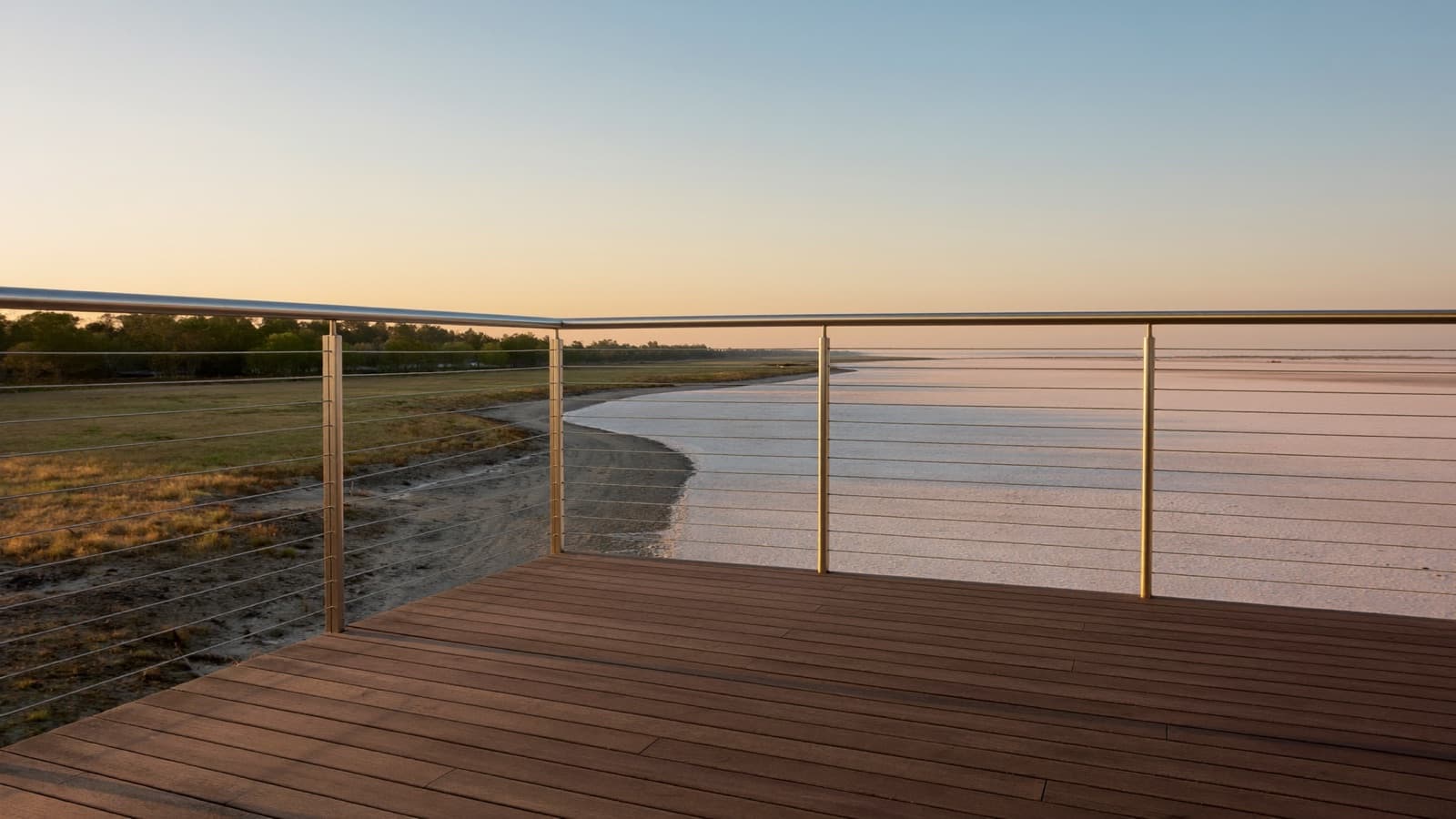
Cable rail exists for one reason, and it's a good one: nearly nothing between you and the view. On a marsh lot in Sneads Ferry or a waterway lot in Swansboro, horizontal stainless cables all but disappear, which is exactly what you paid the waterfront premium for.
Two honest caveats. First, cable railing lives or dies on tensioning — the cables must be properly tensioned at install so they can't be deflected apart, and periodic re-tensioning is a real, recurring task, not a theoretical one. Second, near salt water the hardware must be marine-grade stainless, fittings included; ordinary steel fittings will streak rust down your posts within a couple of seasons. Done right, it's a spectacular system. Done cheap, it's a maintenance story you'll tell at parties.
Glass panels: maximum view, maximum cleaning
Glass railing gives you the most uninterrupted view of anything on this list and creates a genuine wind break — worth something on an exposed lot at North Topsail Beach. Now the honest part: near salt water, glass wears a film of salt spray, pollen, and water spots more or less continuously, and it shows fingerprints the way glass does. If you're not prepared to squeegee your railing the way you'd squeegee a shower, the view advantage over cable rail evaporates behind the haze.
We install it for people who love the look and accept the routine. Go in with open eyes — pun fully intended.
Salt-air hardware rules, whatever system you pick
The railing material gets all the attention, but the fasteners and connectors are what actually fail first near the coast. Our rules on any railing job within reach of salt air: stainless or properly coated structural fasteners, never bare or lightly zinc-plated hardware; marine-grade stainless for anything on a cable system; and don't mix incompatible metals — the wrong fastener in an aluminum rail can set up corrosion right at the connection point.
This is the least visible line item on a quote and the one we'd never let a customer trim. Rust streaks on a two-year-old railing are almost always a hardware story, not a railing story.
Mixing systems: posts from one, infill from another
Railing doesn't have to be one material top to bottom, and some of the best-looking coastal decks mix on purpose: composite or wood posts with slim aluminum balusters between them, aluminum frames with cable infill, or a wood top cap on a metal system so your hand lands on something warm. Mixing lets you put the durable material where the weather hits and the budget-friendly or better-feeling material where it counts.
The one rule: the structural parts — posts and their connections — have to be sized and anchored for the loads regardless of what the infill is. Style is negotiable; the post connection isn't.
What drives railing cost (in relative terms)
No dollar figures here — quotes depend on the deck — but the drivers are consistent. Linear footage is the big one: railing is priced by the foot, so a wraparound deck carries a lot more rail than a simple rectangle with one open side. Corners add posts and labor. Stairs are the most expensive footage on the job — angled rail sections and extra posts take real time. And the material tier does what you'd expect: wood at the bottom, composite kits and aluminum in the middle band, cable and glass at the top, driven mostly by hardware and labor precision.
Our deck cost guide covers how railing fits into the whole project number. When you request a quote, tell us the footage, the corner count, and whether stairs are involved — that's most of the estimate right there.
Which railing for which situation
The short version we give at kitchen tables: wood deck on a budget, wood rail and a stain schedule. Composite deck, composite kit or aluminum for a maintenance-free package. Any deck close to salt water, aluminum is the default answer. Marsh or water view you paid for, cable — with real stainless and a tensioning habit. Showpiece view plus a wind problem, glass and a squeegee.
This is exactly what our deck railing and stairs service handles, whether it's rail for a new build or replacing a wobbly system on a deck that's otherwise fine. Bring us the lot and the view; we'll bring the honest recommendation.
Want a real deck estimate?
Send a few project details and we'll come back with next steps. Most details are optional — share what you can.
- Tap your project type and material
- Name and phone — email optional
- We follow up to schedule the on-site visit
- Written pricing after we measure
Prefer to talk it through?
(910) 708-9268No pressure — we’ll follow up to learn about your project and the next steps.

What's the deck project?
One tap — we'll talk details when we follow up.
Frequently asked questions
What deck railing holds up best to salt air?
Powder-coated aluminum is the most forgiving — no rust, minimal upkeep, and the factory finish handles coastal exposure for years. Composite and PVC systems are a close second since the visible parts don't corrode at all. Whatever you choose, the fasteners and brackets need to be stainless or properly coated; hardware is what actually fails first near the water.
Does cable railing really need re-tensioning?
Yes — that part of its reputation is earned. Cables relax over time and with temperature swings, and a loose cable system stops doing its safety job. Plan on checking tension periodically and snugging it up as needed. It's not difficult, but it's real, recurring maintenance that wood and aluminum rail simply don't have.
Do I need a railing on a low deck?
It depends on how high the deck sits above grade — guardrail requirements kick in at a certain height, and that threshold is a code question for your inspector, not something to guess at. Plenty of people add railing to low decks anyway for looks and for a handhold. For anything elevated, treat railing as non-negotiable.
Can you put a new railing on my existing deck?
Usually, yes — railing replacement is one of the most common jobs we do on decks that are structurally fine but showing their age. The catch is that the new railing is only as good as the frame it anchors to, so we check the rim joists and posts before quoting. If the frame's soft, we'll tell you that first.
Is glass railing practical near the beach?
It's practical if you're honest about the cleaning. Salt film builds on coastal glass continuously, so an uncleaned glass rail loses the view advantage it was bought for. If you want maximum view with less upkeep, cable rail with marine-grade stainless is usually the better fit near the water.
Browse related deck services
Specific services in Jacksonville, NC that connect to this article.
Cable Railing Installation
Stainless cable and wire railing for waterfront porches, decks, and banister upgrades — the view-preserving railing system for coastal Onslow County.
Learn more →Deck Railing & Stairs
Deck railing and stair installation across Jacksonville and Onslow County — wood, composite, aluminum, and cable railing built to guard-height code.
Learn more →Deck Installation
New deck construction across Jacksonville and Onslow County — wood and composite decks built with proper footings, framing, and railings for coastal NC.
Learn more →More from Jacksonville Fence Company
How Much Does a Deck Cost in Jacksonville, Maysville & Coastal NC?
The real drivers of deck pricing in Jacksonville — size, material, railings, stairs, demo, and permits — and why a per-project estimate beats a flat number.
Deck Permits in Jacksonville & Onslow County: Yes, You Need One — Here's What It Involves
Yes, decks need a permit here — what the application takes, the five inspections, and how we pull it for you.
Trex vs. TimberTech: Picking Composite Decking for Coastal NC
Both brands work in coastal NC — here's the framework for choosing, and why the frame matters more than the logo.
Getting Your Deck Hurricane-Ready in Coastal North Carolina
Where decks actually fail in wind — and the pre-season checks and pre-storm steps that matter on the coast.
10 Signs Your Deck Needs Repair — or a Professional Inspection
Soft boards, wobbly rails, rusted hangers, ledger trouble — the ten signs to check and when to call a pro.
Ready for a railing that can handle the salt?
Tell us about your deck — footage, corners, stairs, and how close the water is — and we'll quote the railing options that actually fit your lot and budget. No high-pressure pitch: if your existing rail just needs new hardware and a few posts, we'll say so.